Speak with a licensed insurance agent

1-855-454-9051

TTY user 711 Mon-Fri : 8am-9pm EST

Medicare Advantage Plans in Texas 2027: Costs, Carriers and County Differences

Reviewed by Russell Noga, Licensed Medicare Insurance Broker (all 50 states) — Last updated September 12, 2026

Texas has 254 counties, more than any other state, and your Medicare Advantage options for 2027 are decided in exactly one of them — yours.

That is why statewide comparisons are close to useless here. There are around 156 Medicare Advantage plans available somewhere in Texas, but nobody can buy 156 plans. In Harris County you might see close to 70 options. In Brewster County out by Big Bend, closer to 18. Same state, same rules, completely different menu.

This page covers what Texas actually looks like for the 2027 plan year, which carriers are worth your attention, and what changes are confirmed versus still unknown.

Texas has 254 counties, more than any other state, and your Medicare Advantage options for 2027 are decided in exactly one of them — yours.

That is why statewide comparisons are close to useless here. There are around 156 Medicare Advantage plans available somewhere in Texas, but nobody can buy 156 plans. In Harris County you might see close to 70 options. In Brewster County out by Big Bend, closer to 18. Same state, same rules, completely different menu.

This page covers what Texas actually looks like for the 2027 plan year, which carriers are worth your attention, and what changes are confirmed versus still unknown.

Medicare Advantage in Texas at a Glance

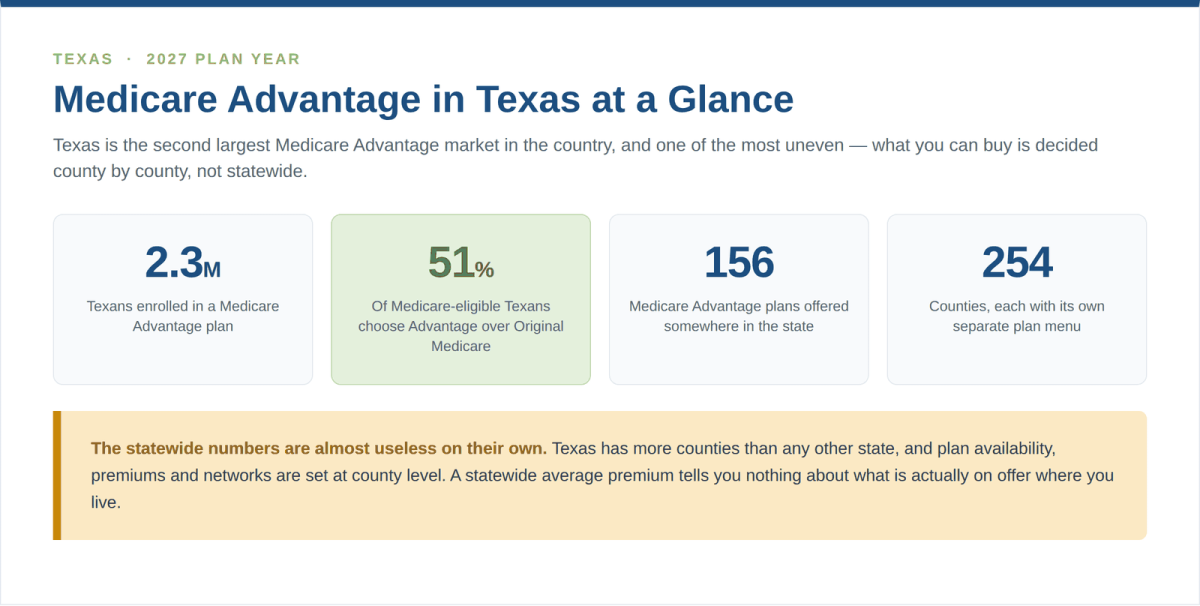
Medicare Advantage in Texas at a glance - 2.3 million enrolled, 51% penetration, 156 plans statewide across 254 counties

Roughly 2.3 million Texans are enrolled in a Medicare Advantage plan, which is about 51% of everyone in the state eligible for Medicare. That makes Texas the second largest Medicare Advantage market in the country behind California, and it puts the state a little below the national average of 55%.

Competition is generally healthy. The statewide average premium sits near $13 a month, and the average star rating across Texas plans is about 3.8 out of 5. But both of those figures are averages across 254 very different markets, and neither tells you much about what is on offer where you live.

Compare Texas Medicare Advantage plans in your zip code

Two Texases, One Medicare Market

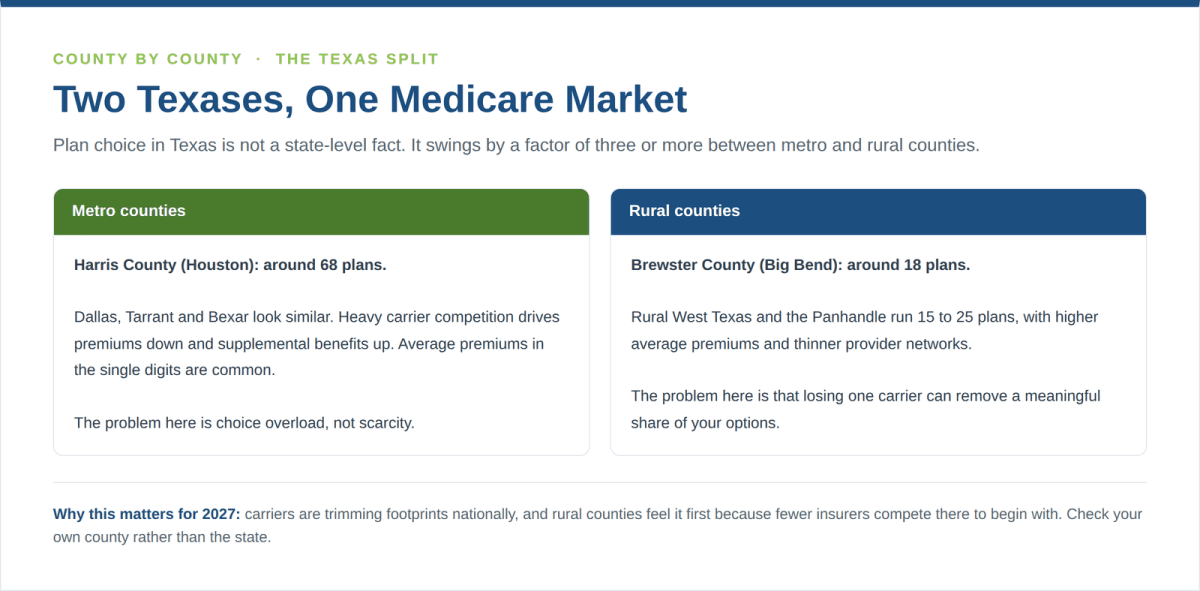
Medicare Advantage plan choice in Texas by county - Harris County 68 plans versus rural Brewster County 18 plans

The gap between metro and rural Texas is the single most important thing to understand about this market.

In the metros — Harris, Dallas, Tarrant, Bexar, Travis — carriers compete hard. Harris County alone carries something close to 68 plans, average premiums run in the single digits, and supplemental benefits like dental are sometimes generous because insurers are fighting for the same members. Your problem there is choice overload, not scarcity.

In rural Texas — West Texas, the Panhandle, the Big Bend counties — you are typically looking at 15 to 25 plans, higher average premiums, and noticeably thinner provider networks. The nearest in-network specialist may be a long drive. And because fewer carriers compete there to begin with, one insurer withdrawing removes a meaningful share of your options rather than a rounding error.

This is why national carrier reviews mislead Texans. A carrier can run an excellent plan in Houston and a poor one two hundred miles west, or not operate there at all. Judge the plan available in your county, not the company’s national reputation.

The Five Texas Metros, Market by Market

Five metros hold most of the Texas Medicare Advantage market, and each one is really a contest between a handful of hospital systems. Because plans are licensed county by county, the practical question in any of them is not which carrier is best nationally — it is which plans contract with the system your doctors already belong to.

Metro Main county What shapes the market
Houston Harris The deepest plan menu in the state, close to 68 options. Houston Methodist, Memorial Hermann, HCA Houston Healthcare and Harris Health all compete, and the Texas Medical Center means specialist access is rarely the constraint. Choice overload is the real problem here.
Dallas Dallas Baylor Scott & White, Texas Health Resources, UT Southwestern, Methodist Health System and Medical City. Networks split cleanly along system lines, so confirming which plans your system takes eliminates most of the field in one step.
Fort Worth Tarrant Shares carriers with Dallas but not always the same networks. Texas Health Resources and Baylor Scott & White dominate. A plan sold across the whole Metroplex can still have different in-network hospitals on each side of it.
San Antonio Bexar Methodist Healthcare, Baptist Health System and University Health. A large dual-eligible population makes Special Needs Plans more relevant here than in most Texas metros — check whether you qualify before comparing standard plans.
Austin Travis Ascension Seton, St. David’s HealthCare and Baylor Scott & White. The fastest-growing metro on this list, which means networks and plan lineups shift more year to year than they do in Houston or Dallas.

Suburban counties are not the same as the metro they border. Collin and Denton north of Dallas, Fort Bend and Montgomery around Houston, Williamson above Austin, Comal and Guadalupe outside San Antonio — each is its own licensing county with its own plan list. A plan advertised as covering the Dallas area may not be sold in Collin County, and the reverse happens just as often. Check your own county, not the metro name.

Outside these five, El Paso and the Rio Grande Valley function as distinct markets with their own carrier mixes, and the rest of the state thins out quickly. Once you are past the metro rings, plan counts fall toward the 15 to 25 range and the drive to an in-network specialist becomes a genuine factor in which plan makes sense.

Which Carriers Compete in Texas

Six carriers account for most of the Texas market. Plan counts, ratings and premiums below reflect the current plan year and will be restated when 2027 data publishes on October 1, 2026.

Carrier Texas plans Avg star rating Worth knowing
Humana ~32 4.0 Largest Texas footprint, but exiting plans covering roughly 600,000 members nationally for 2027
UnitedHealthcare ~28 3.5 Exiting 34 counties across 12 states for 2027
Aetna ~22 3.5 Froze broker commissions on 123 plans nationally, list not published
Cigna ~14 4.0 Smaller footprint, strong ratings where it operates. Now sold under the HealthSpring name
Blue Cross Blue Shield of Texas ~13 3.5 The Texas Blue licensee. BlueCard gives PPO members nationwide network reach
Devoted Health Regional Up to 5.0 Holds one of only two 5-star plans available in parts of Texas. Smaller service area, strong member-experience scores

Two things worth pulling out of that table. Humana has the largest Texas presence and is also making the deepest cuts nationally for 2027, which is a combination worth watching if you are a Humana member here. And Aetna’s commission freeze means some Texas plans will quietly stop being sold without being formally cancelled.

Texas has two 5-star plans available in parts of the state, held by Devoted Health and Texas Independence Health Plan. Neither is available everywhere, and a 5-star plan carries a practical bonus beyond the rating itself — you can switch into one using a Special Enrollment Period at almost any point in the year rather than waiting for Annual Enrollment. If one is offered in your county, it is worth looking at first.

What Changes for Texas in 2027

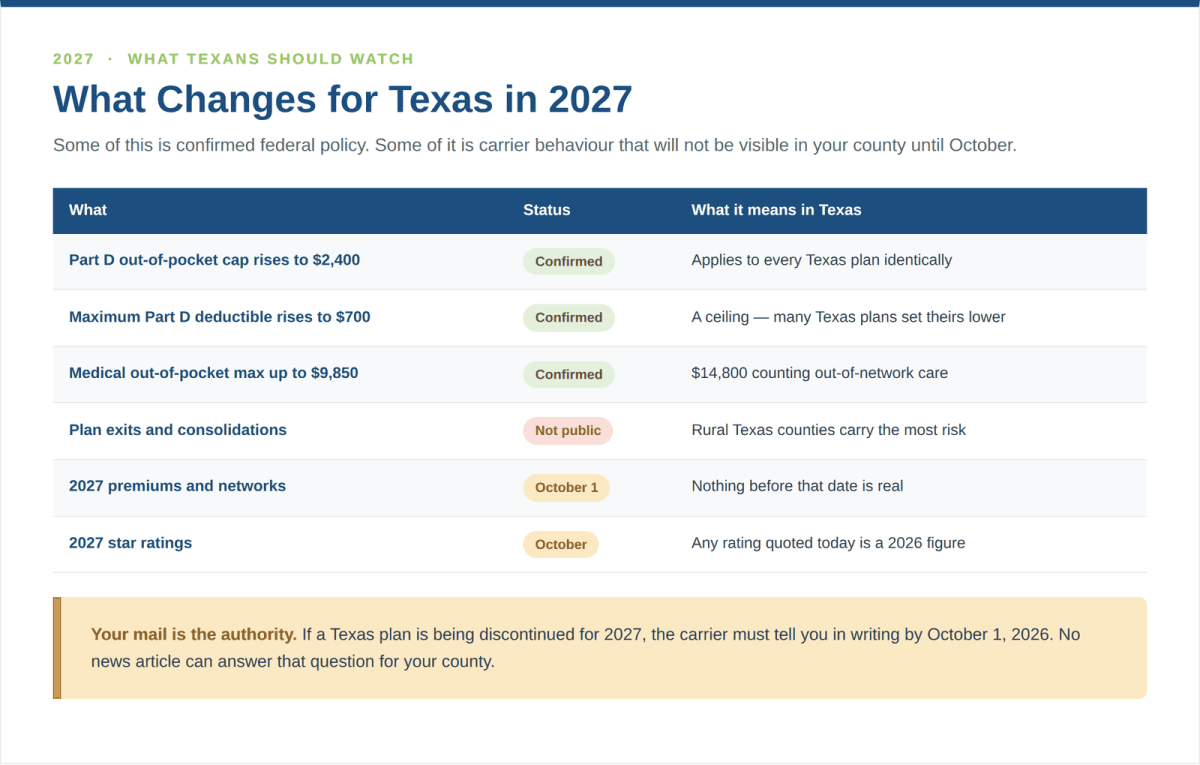
What changes for Texas Medicare Advantage in 2027 - confirmed federal Part D and out-of-pocket figures versus plan details not published until October 1

Some of this is settled federal policy that applies to every plan in the state. The rest is carrier behaviour that will not be visible in your county until October.

Confirmed: the Part D annual out-of-pocket cap rises to $2,400 and the maximum Part D deductible to $700. The Medicare Advantage out-of-pocket maximum can reach $9,850 in network, or $14,800 counting out-of-network care. Insulin stays capped at $35 a month with no deductible.

Not yet known: your county’s 2027 plan list, premiums, networks, formularies and star ratings. All of it publishes October 1, 2026. Anyone quoting you a specific 2027 Texas premium before then is estimating.

The change most likely to affect rural Texans is plan withdrawal. Nationally, about one in ten Medicare Advantage members is in a plan that will not be offered next year. If your plan is among them, the carrier must send you a written non-renewal notice by October 1. Our guide to Medicare Advantage plans going away in 2027 explains how to tell that letter apart from the routine Annual Notice of Change every member receives in September.

Find & Compare Plans Online

Speak with a licensed insurance agent

1-855-454-9051TTY 711

Mon-Fri: 8am-9pm ET

How to Find the Best Medicare Advantage Plan in Texas

There is no single best Medicare Advantage plan in Texas, and anyone who names one has not asked where you live. With 254 counties and roughly 156 plans spread unevenly across them, the best plan is whichever one clears these six checks in your own county.

Check 1

Your county, not your state

Plans, premiums and networks are set county by county. Two neighbours across a county line can have entirely different options, and in Texas that line is crossed more often than almost anywhere.

Check 2

Your doctors and your hospital, by name

This matters more in Texas than in most states because of the distances involved. An out-of-network specialist three hours away is not a practical fallback. Look each one up in the 2027 directory, then call the practice and confirm.

Check 3

Whether you need out-of-network coverage at all

If you split time between a Texas home and somewhere else, or travel regularly, a PPO is worth the extra cost. If you see local doctors, an HMO in the same county is usually cheaper for identical care. Pay for flexibility only if you will use it.

Check 4

Every prescription, at its tier

Formularies are rebuilt annually, and a drug moving up one tier can cost hundreds a year with no change to your premium. Check the tier and whether the plan requires prior authorization.

Check 5

The star rating on the specific plan number

Not the carrier’s Texas average and not its national reputation. CMS rates individual contracts, so a company with a strong statewide figure can still offer a weak plan in your county. Our guide to top rated Medicare Advantage plans explains how to read them.

Check 6

Your mail, through early October

A non-renewal notice is the only reliable confirmation that your plan is ending. Carriers must send it by October 1, 2026. It is a different document from the routine Annual Notice of Change every member receives in September.

When You Can Enroll for 2027

Annual Enrollment runs October 15 through December 7, 2026, for coverage starting January 1, 2027. Choosing inside that window is the only way to guarantee coverage with no gap on January 1.

If you are already in a Medicare Advantage plan, the Medicare Advantage Open Enrollment Period from January 1 to March 31, 2027 allows one further change — switch plans, or go back to Original Medicare with a standalone Part D plan.

A Special Enrollment Period may apply if you move to a different Texas county or out of state, become eligible for Medicaid or Extra Help, or your plan is discontinued. If you are new to Medicare, your Initial Enrollment Period runs from three months before through three months after the month you turn 65. For the national picture, start with our 2027 Medicare Advantage plans guide.

Texas is not the only state where the county you live in decides what you can buy. Florida has the same split between dense metro competition and thin rural coverage, with the added wrinkle of part-year residents who need their plan to work in two states.


Medicare Annual Enrollment Period timeline for 2027 coverage: Annual Notice of Change arrives in September, 2027 plan details publish October 1, enrollment opens October 15 and closes December 7

Compare Texas Medicare Advantage plans in your zip code

Texas Medicare Advantage Plans 2027 — Frequently Asked Questions

  Who has the best Medicare Advantage plan in Texas?

No carrier is best statewide, and in Texas that answer is more emphatic than in most states. Plans are licensed county by county across 254 counties, so a carrier running an excellent plan in Harris County may run a weak one in the Panhandle or not operate there at all. Humana has the largest Texas footprint, Cigna and Humana carry the strongest average ratings among the big carriers, and Devoted Health holds one of only two 5-star plans available in parts of the state. The best plan for you is the one that contracts with your hospital, covers your prescriptions at a workable tier, and sets an out-of-pocket maximum you could absorb in a bad year.

  What will happen to Medicare Advantage plans in 2027?

The market is contracting rather than expanding. Carriers are concentrating on higher-rated, higher-margin plans because contracts at 4 stars and above earn federal bonus payments, and the effect falls hardest on rural counties where fewer carriers compete to begin with. Federally, the Part D out-of-pocket cap rises to $2,400 and the maximum Part D deductible to $700. Plan-level details for every 2027 plan publish October 1, 2026, and any carrier discontinuing a plan must notify affected members in writing by that date.

  What states have 5 star Medicare Advantage plans for seniors?

CMS awards 5 stars to a small number of individual contracts each year rather than to companies or states, and the list is rebuilt annually. A handful of states have several, many have none, and a 5-star contract usually covers only part of the state it operates in. Texas currently has two available in parts of the state, held by Devoted Health and Texas Independence Health Plan. The rating carries a practical benefit beyond quality: you can switch into a 5-star plan using a Special Enrollment Period at almost any point in the year rather than waiting for Annual Enrollment. Our guide to top rated Medicare Advantage plans covers how the ratings are calculated and which contracts hold five stars.

  What is the projected Medicare premium for 2027?

The standard Part B premium for 2027 has not been announced. Medicare typically publishes it in November, several weeks after Annual Enrollment opens, which means most people choose a plan before knowing the exact figure. Any number quoted before that announcement is an estimate rather than a rate. What is already confirmed for 2027 applies to every Medicare Advantage plan regardless of carrier: the Part D out-of-pocket cap is $2,400, the maximum Part D deductible is $700, and the medical out-of-pocket maximum can reach $9,850 in network or $14,800 counting out-of-network care. You continue paying your Part B premium whichever Medicare Advantage plan you join.

  How many Medicare Advantage plans are available in Texas?

Around 156 plans are offered somewhere in Texas, but no one can buy all of them. Availability is set county by county across the state’s 254 counties. Harris County has close to 68 plans, while rural counties such as Brewster typically have 15 to 25. Your own county’s list is the only one that matters, and the 2027 lists publish October 1, 2026.

  How much do Medicare Advantage plans cost in Texas?

The statewide average premium is roughly $13 a month, and many Texas plans carry a $0 premium. Metro counties tend to run lower than rural ones because more carriers compete there. You continue paying your Part B premium regardless of which plan you choose. For 2027, the confirmed federal figures are a $2,400 Part D out-of-pocket cap, a $700 maximum Part D deductible, and a medical out-of-pocket maximum of up to $9,850 in network or $14,800 combined. Specific 2027 premiums publish October 1, 2026.

  Which carriers offer Medicare Advantage plans in Texas?

Humana has the largest Texas footprint with roughly 32 plans, followed by UnitedHealthcare at about 28, Aetna at 22, Cigna at 14 and Blue Cross Blue Shield of Texas at 13. Devoted Health operates a smaller regional footprint but holds one of the two 5-star plans available in the state. Availability differs sharply by county, so a carrier with a large statewide presence may not operate where you live. Star ratings across these carriers in Texas range from about 3.5 to 5.0 depending on the specific contract.

  Why do Medicare Advantage plans differ so much between Texas counties?

Medicare Advantage is licensed and priced at county level, not state level, and carriers only enter counties where they can build a provider network and make the economics work. Texas has 254 counties spanning dense metros and very sparse rural areas, so the spread is wider here than almost anywhere. Harris County supports around 68 plans; Big Bend country supports roughly 18. Population density, hospital availability and physician supply drive the difference.

  What percentage of Texans are on Medicare Advantage?

About 51% of Medicare-eligible Texans are enrolled in a Medicare Advantage plan, roughly 2.3 million people. That is slightly below the national figure of 55% but makes Texas the second largest Medicare Advantage market in the country behind California. Penetration is higher in the metros and lower in rural counties where fewer plans are offered.

  Are Texas Medicare Advantage plans going away in 2027?

Some will be, though the county-level lists are not public yet. Nationally about one in ten Medicare Advantage members is in a plan that will not be offered in 2027, with Humana exiting plans covering roughly 600,000 members and UnitedHealthcare leaving 34 counties across 12 states. Rural Texas carries the most risk because fewer carriers compete there. If your plan is ending, the carrier must send you a written non-renewal notice by October 1, 2026 — that letter, not news coverage, is the answer for your plan.

  Should I choose an HMO or a PPO in Texas?

It depends on distance and travel more than on price. An HMO keeps you in a defined local network and is usually cheaper for identical care, which works well if your doctors and hospital are close by. A PPO covers care outside the network at a higher cost share and needs no referrals, which matters in Texas if you travel, split time between two homes, or live far enough from a metro that specialist care means a long drive. Pay for the flexibility only if you will actually use it.

  What happens to my Texas plan if I move to another county?

Moving out of your plan’s service area triggers a Special Enrollment Period, which lets you change plans outside the normal enrollment windows. Because Texas plans are county-based, this can apply even for a move within the state — from Dallas County to Collin County, for example. Notify your plan before you move if you can; your enrollment window generally runs from the month before the move through two months after.

  When can I enroll in a Texas Medicare Advantage plan for 2027?

Annual Enrollment runs October 15 through December 7, 2026, for coverage beginning January 1, 2027. If you are already in a Medicare Advantage plan, the Medicare Advantage Open Enrollment Period from January 1 to March 31, 2027 allows one further change. A Special Enrollment Period may apply if you move counties or out of state, become eligible for Medicaid or Extra Help, or your plan is discontinued. If you are new to Medicare, your Initial Enrollment Period spans the three months before through the three months after the month you turn 65.


Have Questions?

Speak with a licensed insurance agent

1-855-454-9051

TTY users 711

Mon-Fri: 8am-9pm ET

Find & Compare Plans Online

Speak with a licensed insurance agent

1-855-454-9051TTY 711

Mon-Fri: 8am-9pm ET

ZRN Health & Financial Services, LLC, a Texas limited liability company