➤ Who has the best Medicare Advantage plan in Texas?
No carrier is best statewide, and in Texas that answer is more emphatic than in most states. Plans are licensed county by county across 254 counties, so a carrier running an excellent plan in Harris County may run a weak one in the Panhandle or not operate there at all. Humana has the largest Texas footprint, Cigna and Humana carry the strongest average ratings among the big carriers, and Devoted Health holds one of only two 5-star plans available in parts of the state. The best plan for you is the one that contracts with your hospital, covers your prescriptions at a workable tier, and sets an out-of-pocket maximum you could absorb in a bad year.
➤ What will happen to Medicare Advantage plans in 2027?
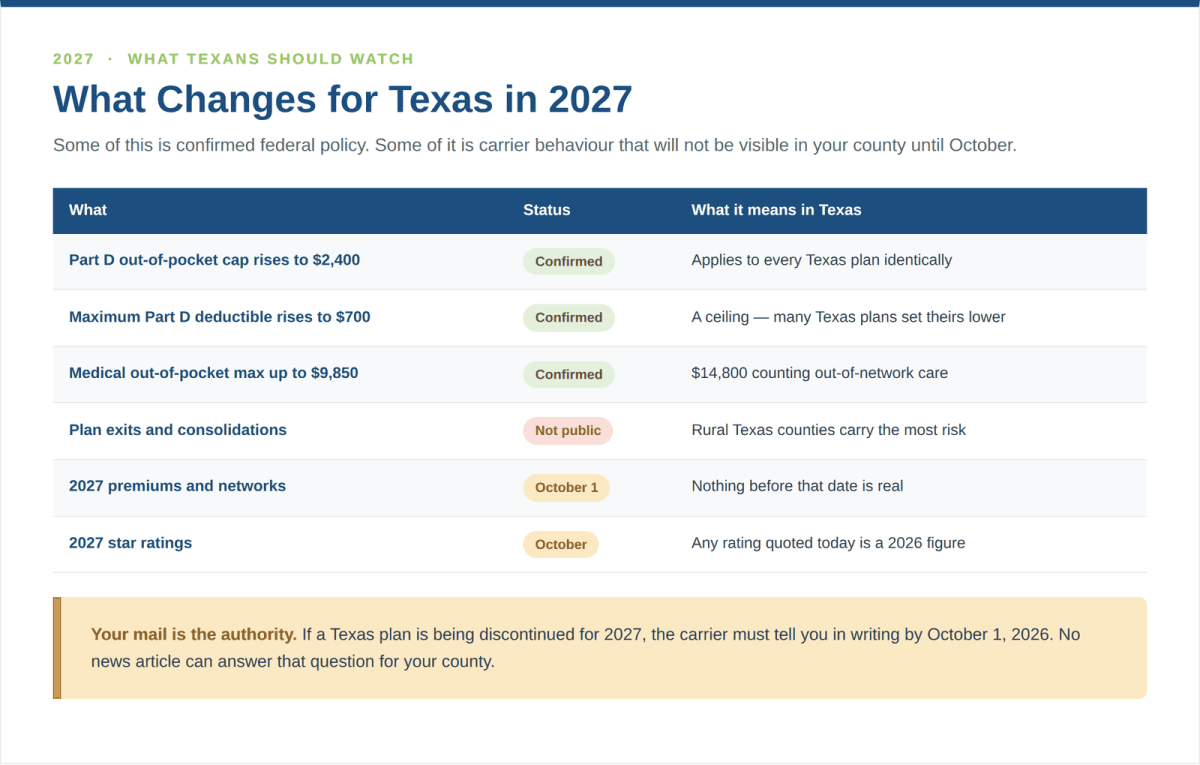
The market is contracting rather than expanding. Carriers are concentrating on higher-rated, higher-margin plans because contracts at 4 stars and above earn federal bonus payments, and the effect falls hardest on rural counties where fewer carriers compete to begin with. Federally, the Part D out-of-pocket cap rises to $2,400 and the maximum Part D deductible to $700. Plan-level details for every 2027 plan publish October 1, 2026, and any carrier discontinuing a plan must notify affected members in writing by that date.
➤ What states have 5 star Medicare Advantage plans for seniors?
CMS awards 5 stars to a small number of individual contracts each year rather than to companies or states, and the list is rebuilt annually. A handful of states have several, many have none, and a 5-star contract usually covers only part of the state it operates in. Texas currently has two available in parts of the state, held by Devoted Health and Texas Independence Health Plan. The rating carries a practical benefit beyond quality: you can switch into a 5-star plan using a Special Enrollment Period at almost any point in the year rather than waiting for Annual Enrollment. Our guide to top rated Medicare Advantage plans covers how the ratings are calculated and which contracts hold five stars.
➤ What is the projected Medicare premium for 2027?
The standard Part B premium for 2027 has not been announced. Medicare typically publishes it in November, several weeks after Annual Enrollment opens, which means most people choose a plan before knowing the exact figure. Any number quoted before that announcement is an estimate rather than a rate. What is already confirmed for 2027 applies to every Medicare Advantage plan regardless of carrier: the Part D out-of-pocket cap is $2,400, the maximum Part D deductible is $700, and the medical out-of-pocket maximum can reach $9,850 in network or $14,800 counting out-of-network care. You continue paying your Part B premium whichever Medicare Advantage plan you join.
➤ How many Medicare Advantage plans are available in Texas?
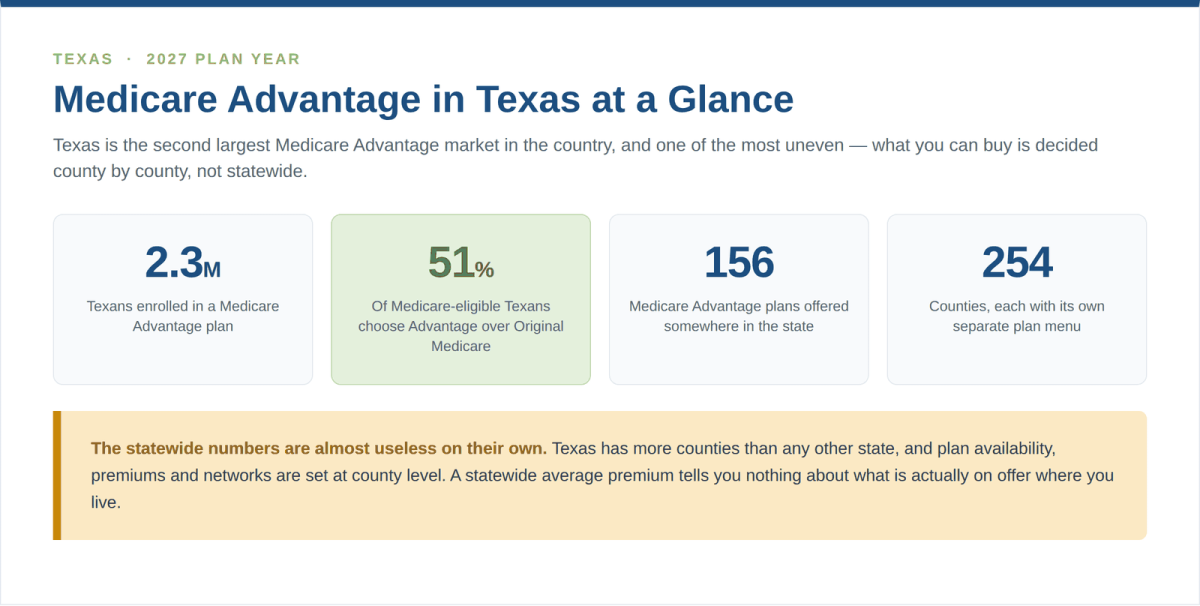
Around 156 plans are offered somewhere in Texas, but no one can buy all of them. Availability is set county by county across the state’s 254 counties. Harris County has close to 68 plans, while rural counties such as Brewster typically have 15 to 25. Your own county’s list is the only one that matters, and the 2027 lists publish October 1, 2026.
➤ How much do Medicare Advantage plans cost in Texas?
The statewide average premium is roughly $13 a month, and many Texas plans carry a $0 premium. Metro counties tend to run lower than rural ones because more carriers compete there. You continue paying your Part B premium regardless of which plan you choose. For 2027, the confirmed federal figures are a $2,400 Part D out-of-pocket cap, a $700 maximum Part D deductible, and a medical out-of-pocket maximum of up to $9,850 in network or $14,800 combined. Specific 2027 premiums publish October 1, 2026.
➤ Which carriers offer Medicare Advantage plans in Texas?
Humana has the largest Texas footprint with roughly 32 plans, followed by UnitedHealthcare at about 28, Aetna at 22, Cigna at 14 and Blue Cross Blue Shield of Texas at 13. Devoted Health operates a smaller regional footprint but holds one of the two 5-star plans available in the state. Availability differs sharply by county, so a carrier with a large statewide presence may not operate where you live. Star ratings across these carriers in Texas range from about 3.5 to 5.0 depending on the specific contract.
➤ Why do Medicare Advantage plans differ so much between Texas counties?
Medicare Advantage is licensed and priced at county level, not state level, and carriers only enter counties where they can build a provider network and make the economics work. Texas has 254 counties spanning dense metros and very sparse rural areas, so the spread is wider here than almost anywhere. Harris County supports around 68 plans; Big Bend country supports roughly 18. Population density, hospital availability and physician supply drive the difference.
➤ What percentage of Texans are on Medicare Advantage?
About 51% of Medicare-eligible Texans are enrolled in a Medicare Advantage plan, roughly 2.3 million people. That is slightly below the national figure of 55% but makes Texas the second largest Medicare Advantage market in the country behind California. Penetration is higher in the metros and lower in rural counties where fewer plans are offered.
➤ Are Texas Medicare Advantage plans going away in 2027?
Some will be, though the county-level lists are not public yet. Nationally about one in ten Medicare Advantage members is in a plan that will not be offered in 2027, with Humana exiting plans covering roughly 600,000 members and UnitedHealthcare leaving 34 counties across 12 states. Rural Texas carries the most risk because fewer carriers compete there. If your plan is ending, the carrier must send you a written non-renewal notice by October 1, 2026 — that letter, not news coverage, is the answer for your plan.
➤ Should I choose an HMO or a PPO in Texas?
It depends on distance and travel more than on price. An HMO keeps you in a defined local network and is usually cheaper for identical care, which works well if your doctors and hospital are close by. A PPO covers care outside the network at a higher cost share and needs no referrals, which matters in Texas if you travel, split time between two homes, or live far enough from a metro that specialist care means a long drive. Pay for the flexibility only if you will actually use it.
➤ What happens to my Texas plan if I move to another county?
Moving out of your plan’s service area triggers a Special Enrollment Period, which lets you change plans outside the normal enrollment windows. Because Texas plans are county-based, this can apply even for a move within the state — from Dallas County to Collin County, for example. Notify your plan before you move if you can; your enrollment window generally runs from the month before the move through two months after.
➤ When can I enroll in a Texas Medicare Advantage plan for 2027?
Annual Enrollment runs October 15 through December 7, 2026, for coverage beginning January 1, 2027. If you are already in a Medicare Advantage plan, the Medicare Advantage Open Enrollment Period from January 1 to March 31, 2027 allows one further change. A Special Enrollment Period may apply if you move counties or out of state, become eligible for Medicaid or Extra Help, or your plan is discontinued. If you are new to Medicare, your Initial Enrollment Period spans the three months before through the three months after the month you turn 65.