Speak with a licensed insurance agent

1-855-454-9051

TTY user 711 Mon-Fri : 8am-9pm EST

Original Medicare vs Medicare Advantage 2027 - Compared

Reviewed by Russell Noga, Licensed Medicare Insurance Broker (all 50 states) — Last updated September 8, 2026

This is the first real decision anyone makes about Medicare, and the wording of it confuses people before they start. Medicare Advantage is not something you add to Medicare. It is a different way of receiving the same Medicare benefits — through a private insurer instead of directly from the federal government. You are in one or the other, never both at once.

Fifty-five percent of eligible beneficiaries are now in Medicare Advantage: 35.2 million people out of 64.2 million. That does not make it the right answer for everyone. What follows is the comparison as it actually stands going into 2027, including the gap in Original Medicare that most articles mention in passing and then move on from.

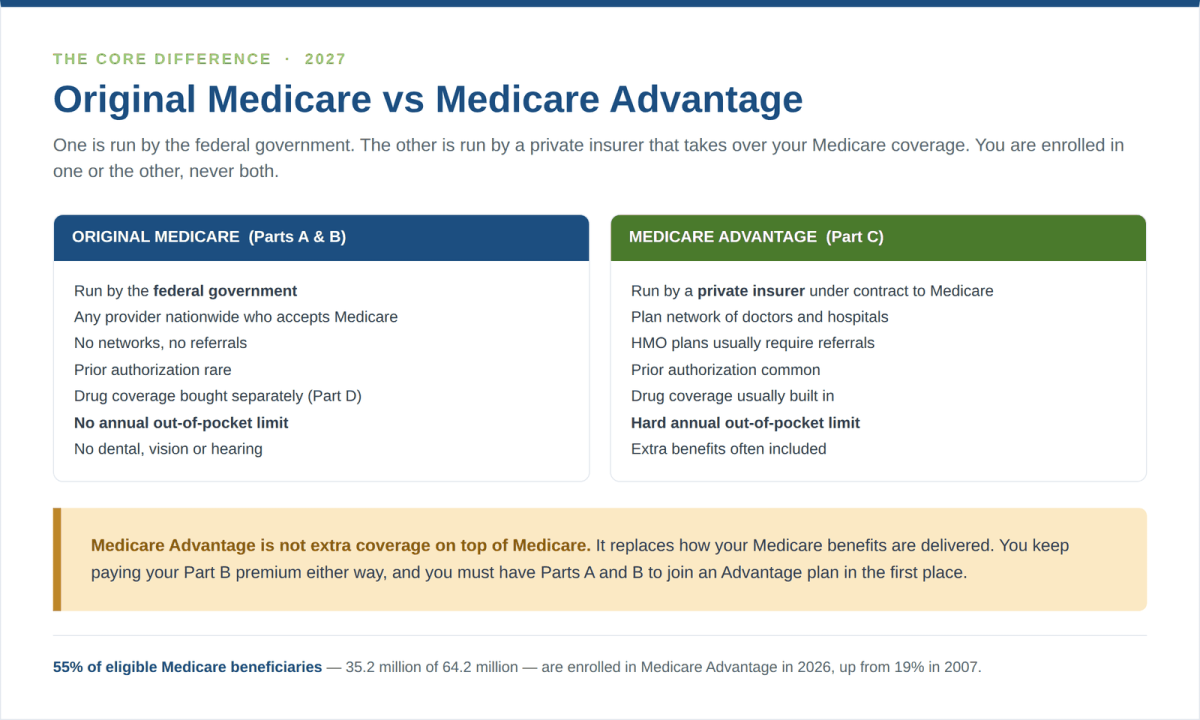
Original Medicare vs Medicare Advantage side-by-side comparison of coverage, networks and costs for 2027

The Core Difference

Original Medicare is Part A and Part B, administered by the federal government. Medicare Advantage is Part C, where a private insurer contracts with Medicare to deliver your Part A and Part B benefits through its own plan. Everything else that separates them follows from that one structural fact.

Original Medicare is government-run and network-free

You use your red, white and blue Medicare card at any provider in the country who accepts Medicare, which is the vast majority of them. There is no network to check, no referral to get, and prior authorization is rare. What you give up is breadth of coverage: no drug plan, no dental or vision, and no limit on what a bad year can cost you.

Medicare Advantage is insurer-run and network-based

You get a card from the carrier and use the plan’s network of doctors and hospitals. Drug coverage is usually built in, extra benefits are common, and there is a hard ceiling on your annual medical costs. What you accept is the network, the referral rules on HMO plans, and prior authorization on certain services.

You keep paying Part B either way. To join a Medicare Advantage plan you must already be enrolled in Parts A and B, and you keep paying the Part B premium while you are on the plan. A $0 premium Advantage plan means $0 for the plan itself, not $0 for Medicare.

Compare 2027 Medicare plans and enroll online

What Each One Costs in 2027

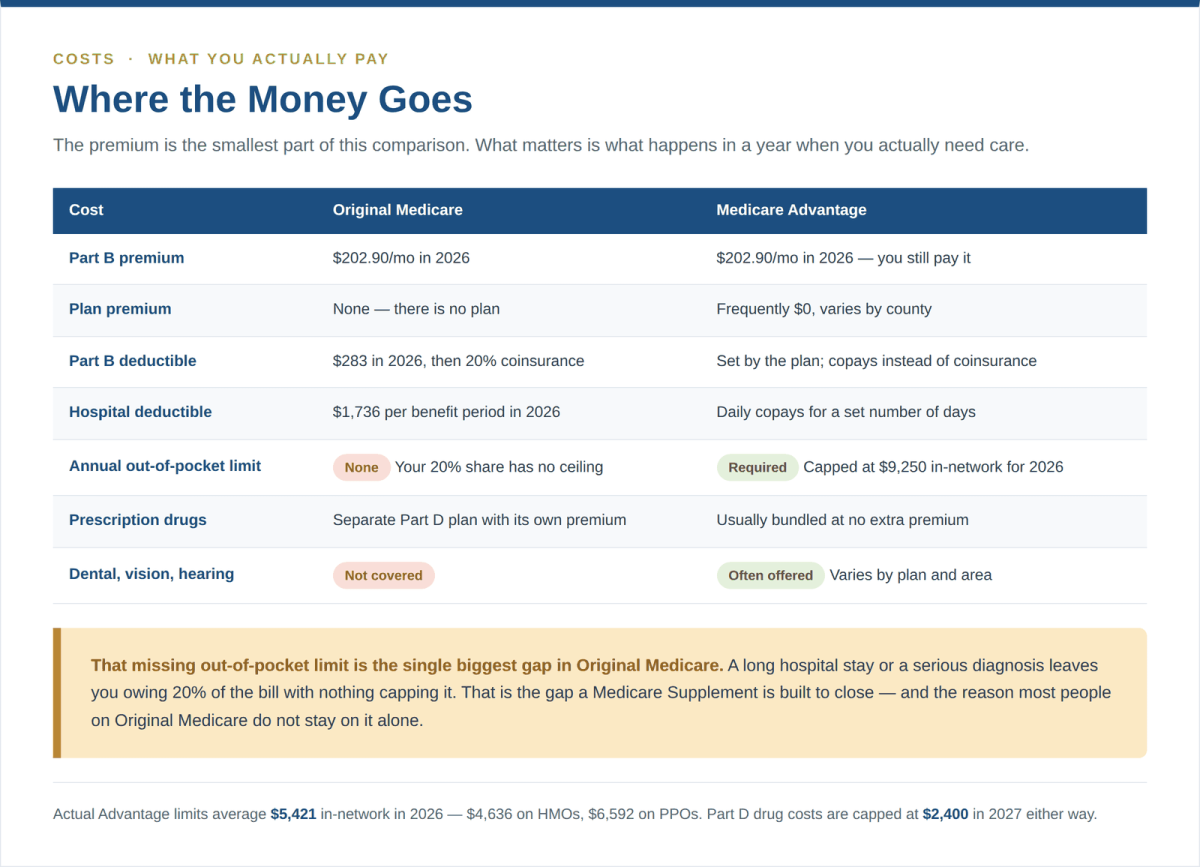
Original Medicare vs Medicare Advantage cost comparison showing premiums, deductibles and out-of-pocket limits
Cost Original Medicare Medicare Advantage
Part B premium $202.90 a month in 2026 for most people The same — you still pay it
Plan premium None, because there is no plan Frequently $0, though premium plans exist; varies by county
Part B deductible and coinsurance $283 in 2026, then you pay 20% of the Medicare-approved amount Set by the plan, usually flat copays per visit instead of coinsurance
Hospital costs $1,736 deductible per benefit period in 2026, and a benefit period can restart within the same year Daily copays for a set number of days, then $0 for the rest of the stay
Annual out-of-pocket limit None. Your 20% share has no ceiling in any year Required. Capped at $9,250 in-network for 2026, with plans averaging $5,421
Prescription drugs A separate Part D plan with its own premium Usually bundled into the plan at no additional premium
Dental, vision, hearing Not covered at all Commonly offered, though what is included varies by plan and by area

The Gap in Original Medicare Nobody Should Skip Past

Original Medicare has no annual out-of-pocket maximum. Not a high one — none at all. After the deductible you owe 20% of the Medicare-approved amount for most Part B services, and there is nothing that stops that 20% from growing.

Twenty percent of a small bill is small. Twenty percent of a cancer treatment year is not. Chemotherapy, dialysis, an extended hospital course, a complex surgery with follow-up — those are the scenarios where an uncapped 20% turns into five figures. This is the single strongest argument against staying on Original Medicare with nothing behind it, and it is why very few people do.

There are two ways to close that gap. One is a Medicare Advantage plan, which is legally required to cap your in-network costs — the ceiling cannot exceed $9,250 for 2026 and most plans set theirs well below it, averaging $5,421 across all enrollees. The other is a Medicare Supplement policy sitting on top of Original Medicare, which pays the deductibles and coinsurance for you. That comparison is its own decision, and we cover it in detail in Medigap vs Medicare Advantage.

The honest framing is this: the real-world comparison is rarely Original Medicare alone against Medicare Advantage. It is Original Medicare plus a supplement plus a drug plan, against a single Advantage plan that bundles all three functions together.

Doctor Access, Referrals and Travel

For many people this decides it, regardless of the numbers.

1Original Medicare has no network. Any doctor, hospital or specialist in the country who accepts Medicare will see you, and the great majority do. No referrals, no in-network list, no service area. If you spend part of the year in another state or want access to a specific out-of-state facility, this is the reason people stay with it.

2Medicare Advantage builds coverage around a service area. HMO plans generally require you to stay in network and route specialist care through a primary care doctor. PPO plans allow out-of-network care at higher cost. Emergency care is covered anywhere either way, but routine care outside the service area usually is not.

3Prior authorization is largely a Medicare Advantage feature. Advantage plans can require approval before certain procedures, imaging or admissions go ahead. Original Medicare rarely works that way. How much that matters depends entirely on the kind of care you expect to need.

Networks are also renegotiated annually, even on plans that continue unchanged in every other respect. If you are comparing Advantage plans on quality rather than price alone, our roundup of top rated Medicare Advantage plans is a reasonable place to start.

Find & Compare Plans Online

Speak with a licensed insurance agent

1-855-454-9051TTY 711

Mon-Fri: 8am-9pm ET

Which One Fits You

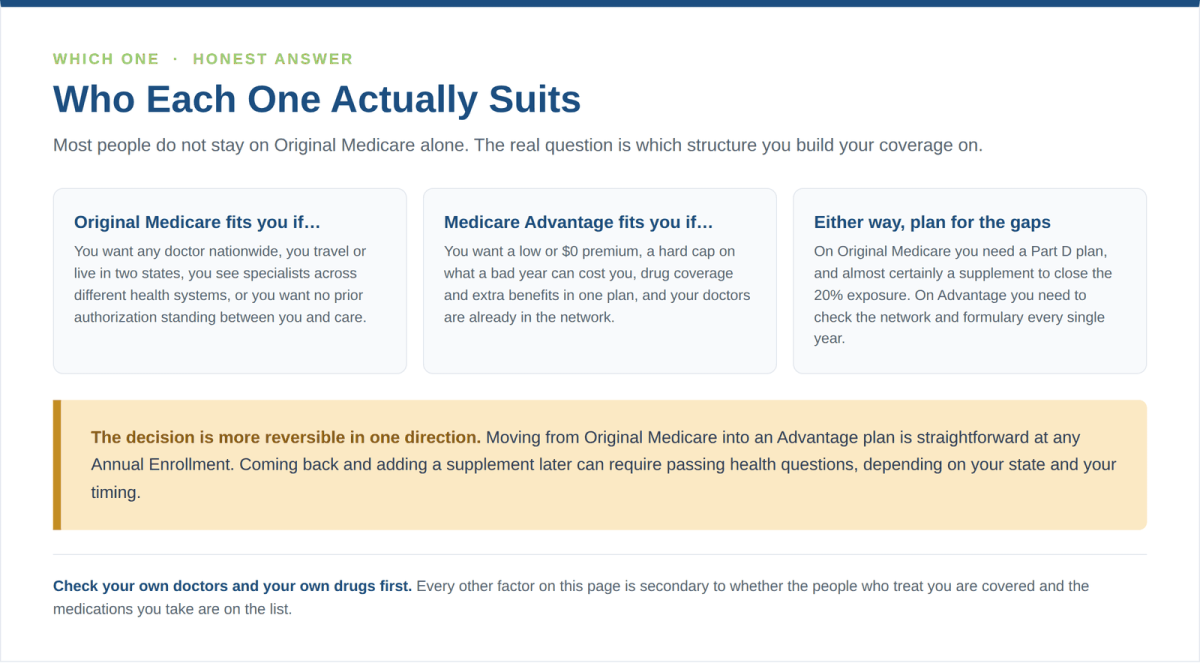
Who Original Medicare suits and who Medicare Advantage suits when choosing coverage for 2027

There is no universal answer here, and anyone who gives you one without asking about your doctors, your prescriptions and your budget is selling rather than advising.

Original Medicare tends to fit you if

You want any doctor in the country without checking a list, you travel or split the year between two states, you see specialists across more than one health system, or you want nothing standing between a doctor’s recommendation and the care happening. It also suits people who would rather decide once than review a plan every autumn. Add a Part D plan for drugs, and seriously consider a supplement to close the 20% exposure.

Medicare Advantage tends to fit you if

A low or $0 plan premium matters to your budget, you want one card and one plan rather than three separate pieces, your doctors are already in a network, and you value a hard ceiling on what a bad year can cost. The extra benefits that often come attached — dental, vision, hearing — are real, though what is included varies by plan and by area.

Plan quality varies enormously between carriers, which is worth knowing before you judge Medicare Advantage as a category. Kaiser Medicare Advantage rates 4 stars or better on every plan it sells, while other carriers have most of their members in plans rated well below that. The structure is not the whole story — the carrier is.

Look harder before deciding if

You have a chronic condition, take expensive specialty medications, or receive care across several health systems. Those are precisely the situations where networks, prior authorization and formulary decisions carry the most weight, and where the cheaper monthly number can end up being the more expensive year.

Switching Between Them

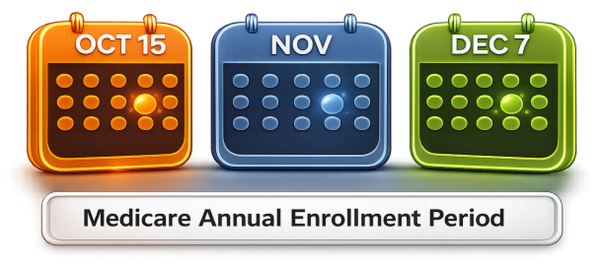
Medicare Annual Enrollment Period timeline for 2027 coverage: Annual Notice of Change arrives in September, 2027 plan details publish October 1, enrollment opens October 15 and closes December 7

Annual Enrollment runs October 15 through December 7, 2026, for coverage starting January 1, 2027. During it you can move from Original Medicare into an Advantage plan, switch between Advantage plans, or drop an Advantage plan and return to Original Medicare. If you are already in an Advantage plan, the Medicare Advantage Open Enrollment Period from January 1 to March 31, 2027 gives you one further change.

The move is easier in one direction than the other. Going from Original Medicare into an Advantage plan is straightforward at any Annual Enrollment. Coming back to Original Medicare is also straightforward — but adding a Medicare Supplement once you are back is not guaranteed. Outside your initial six-month Medigap window or a specific guaranteed-issue situation, most states allow insurers to ask health questions and decline you. Returning to Original Medicare without a supplement leaves you back at the uncapped 20%.

If you are leaning toward Advantage, our guide to Medicare Advantage plans for 2027 covers plan types, what changes each year and how to compare them properly. And if you have heard that carriers are pulling out of markets, are Medicare Advantage plans going away in 2027 separates what is actually happening from what is not.

The timing rules are their own subject, and getting them wrong costs a year. Our guide to when you can change plans covers all six enrollment windows, which ones you qualify for, and what each one actually lets you do.

Some people arrive at this decision from a third direction entirely. In states like Minnesota, where Medicare Cost plans once dominated, hundreds of thousands of beneficiaries were moved out of a hybrid product that behaved like Original Medicare outside the network, and had to choose between these two options for the first time.

Compare plans and enroll online

Frequently Asked Questions

  What is the difference between Original Medicare and Medicare Advantage?

Original Medicare is Parts A and B, run by the federal government, usable at any provider nationwide that accepts Medicare. Medicare Advantage is Part C, where a private insurer delivers those same Part A and Part B benefits through its own plan with its own network, copays and usually built-in drug coverage. You are enrolled in one or the other, not both.

  Is Medicare Advantage better than Original Medicare?

Neither is better in the abstract. Medicare Advantage gives you a capped annual cost, bundled drug coverage and extra benefits in exchange for using a network and accepting prior authorization. Original Medicare gives you nationwide provider access and few restrictions, but no cap on your 20% share and no drug coverage unless you add a Part D plan. The right answer depends on your doctors, your medications and how much unpredictability you can absorb.

  Do I still pay the Part B premium on a Medicare Advantage plan?

Yes. You must be enrolled in Parts A and B to join a Medicare Advantage plan, and you keep paying the Part B premium the whole time you are on it — $202.90 a month in 2026 for most people. A $0 premium Advantage plan means the plan itself charges nothing extra, not that Medicare is free. Some plans offer a partial giveback that reduces the amount taken from your Social Security check.

  Does Original Medicare have an out-of-pocket maximum?

No, and this is its most important limitation. After the annual Part B deductible you pay 20% of the Medicare-approved amount for most services, with no annual ceiling. Medicare Advantage plans are required to have one — it may not exceed $9,250 for in-network services in 2026, and plans average $5,421. To get a similar protection on Original Medicare you would add a Medicare Supplement policy.

  Does Original Medicare cover prescription drugs?

Not on its own. You add a standalone Part D plan, and you should do it when you first become eligible even if you take no medications, because enrolling late without other creditable coverage triggers a penalty added to your premium permanently. Most Medicare Advantage plans include drug coverage in the plan. Either way, your Part D out-of-pocket costs are capped at $2,400 in 2027.

  Can I keep my own doctors on Medicare Advantage?

Only if they are in that plan’s network. On Original Medicare the question barely arises, because nearly every provider in the country accepts Medicare. On Medicare Advantage you should look up each of your physicians and your preferred hospital against the plan’s directory for the coming year, then confirm with the practice directly — directories are not always current, and networks are renegotiated annually.

  Which is better if I travel or live in two states?

Original Medicare, in most cases. It has no service area, so routine care in a second state is not a problem. Medicare Advantage coverage is built around a county-level service area, and while emergency care is covered anywhere, routine care outside the area generally is not. Some PPO plans handle travel better than HMOs, but none match Original Medicare’s reach.

  How many people choose Medicare Advantage?

In 2026, 55% of eligible Medicare beneficiaries are enrolled in Medicare Advantage — 35.2 million people out of 64.2 million. That is up from 19% in 2007. Popularity is not the same as suitability, though; the growth says as much about $0 premiums and marketing reach as it does about fit.

  Can I switch from Medicare Advantage back to Original Medicare?

Yes, during Annual Enrollment from October 15 to December 7, or during the Medicare Advantage Open Enrollment Period from January 1 to March 31 if you are currently in an Advantage plan. Returning to Original Medicare is not the hard part. Adding a Medicare Supplement afterward is, because outside a guaranteed-issue situation most states let insurers use medical underwriting and decline you.

  What is prior authorization and does Original Medicare use it?

Prior authorization is approval from the insurer before a procedure, scan or hospital admission goes ahead. Medicare Advantage plans use it on certain services; Original Medicare rarely does. Whether it matters to you depends on the care you expect to need, but it is a genuine difference in how quickly things move when a doctor recommends something.

Have Questions?

Speak with a licensed insurance agent

1-855-454-9051

TTY users 711

Mon-Fri: 8am-9pm ET

Find & Compare Plans Online

Speak with a licensed insurance agent

1-855-454-9051TTY 711

Mon-Fri: 8am-9pm ET

ZRN Health & Financial Services, LLC, a Texas limited liability company