Speak with a licensed insurance agent

1-855-454-9051

TTY user 711 Mon-Fri : 8am-9pm EST

Medicare Advantage Plans in Minnesota 2027: Costs, Carriers and Coverage

Reviewed by Russell Noga, Licensed Medicare Insurance Broker (all 50 states) — Last updated September 11, 2026

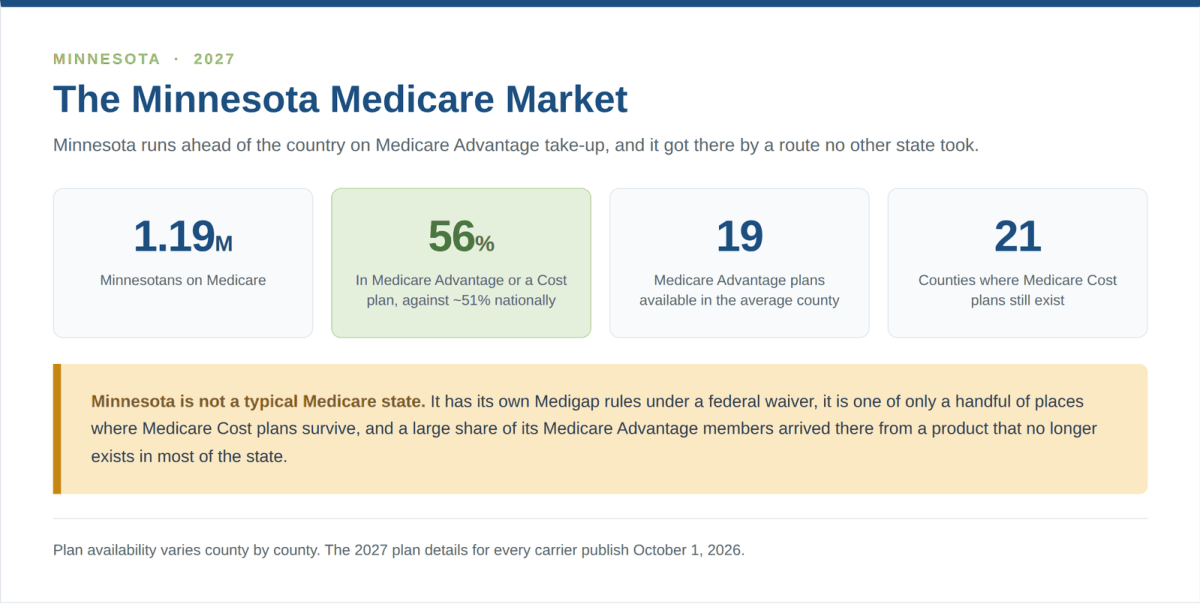
Minnesota is not a typical Medicare state, and if you compare plans here the way you would in Ohio or Arizona, you will miss the things that actually matter. Roughly 1.19 million Minnesotans are on Medicare, and about 56% of them are enrolled in a Medicare Advantage plan or a Medicare Cost plan — ahead of the national figure of around 51%.

More importantly, a large share of those people did not arrive at Medicare Advantage the usual way. They came out of a product called a Medicare Cost plan, which Minnesota had more of than anywhere else in the country, and which largely disappeared at the end of 2018.

That history shapes how plans are sold here, which carriers hold share, and which questions you need to ask before you enroll. This page walks through the Minnesota market for the 2027 plan year: who sells here, what plans cost, how networks work in a state that is half dense metro and half wide-open rural, and when you can actually make a change.

If you want the national picture first, start with our overview of Medicare Advantage plans for 2027 and then come back for the Minnesota specifics.

Minnesota Medicare market overview showing 1.19 million beneficiaries and 56 percent enrolled in Medicare Advantage or Cost plans

Medicare Advantage in Minnesota at a Glance

Minnesota runs ahead of the national average on Medicare Advantage take-up, and plan choice here is genuinely competitive. The average Minnesota county has around 19 Medicare Advantage plans available. In the Twin Cities metro the number is considerably higher; in the far northwest and along the Iowa border it is considerably lower. Statewide averages are useful for orientation and useless for decision-making, which is why every recommendation on this page comes back to your own county.

How far a state sits from the national average says a lot about what shopping there feels like. Minnesota’s 56% is driven by a history no other state shares. Medicare Advantage plans in Florida reach an even higher share of beneficiaries, but for the opposite reason — sheer carrier density and decades of competition rather than a single product transition.

The three things that make Minnesota unusual

1. Medicare Cost plans. Minnesota was the national center of a product almost no other state had at scale. Most of it went away in 2018, and where it went, Medicare Advantage filled the gap.

2. Local carriers that actually compete. Minnesota-based nonprofit health plans hold real Medicare Advantage market share here, which is not the case in most states.

3. Its own Medicare Supplement rules. Minnesota is one of three states operating under a federal waiver with a completely different set of supplement plan designs. That changes what the alternative to Medicare Advantage looks like.

Compare Medicare plans in Minnesota

Why Minnesota Is Different: The Medicare Cost Plan Story

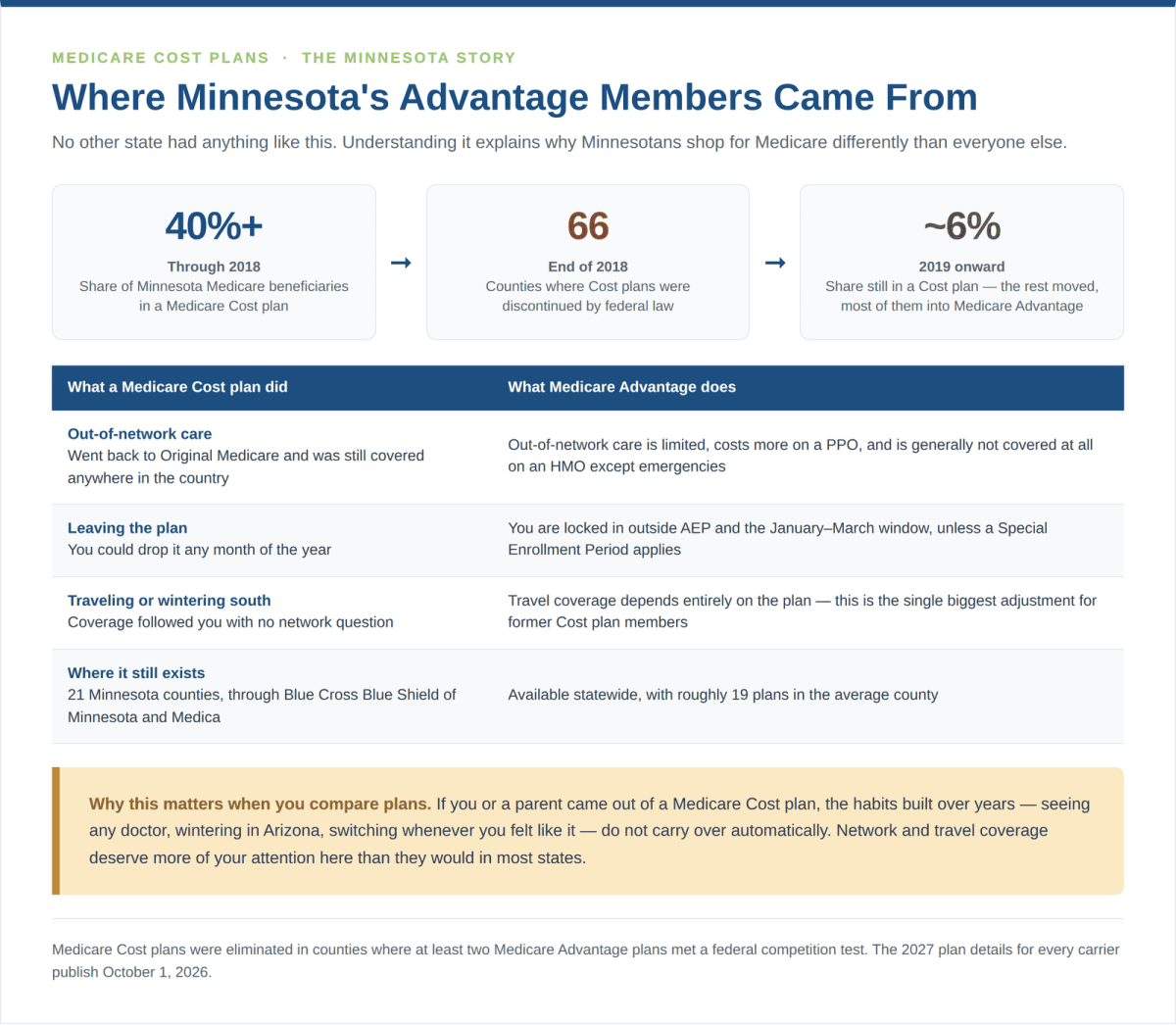
Minnesota Medicare Cost plan transition from over 40 percent enrollment through 2018 to about 6 percent from 2019 onward

A Medicare Cost plan was a hybrid. You enrolled with a private insurer and used its network, but if you went outside that network, the care simply reverted to Original Medicare and was covered anywhere in the country. You could also drop the plan in any month of the year rather than waiting for an enrollment window. For a state with a large population of retirees who spend winters in Arizona, Texas or Florida, that combination was close to ideal, and Minnesota adopted it more heavily than anywhere else. Through 2018, more than 40% of Minnesota Medicare beneficiaries were in one.

Federal law then required Cost plans to be discontinued in any county where at least two Medicare Advantage plans met a competition test. At the end of 2018 that eliminated them in 66 Minnesota counties. Enrollment collapsed to roughly 6% the following year. Most of those members moved into Medicare Advantage. Cost plans still exist in 21 Minnesota counties through Blue Cross Blue Shield of Minnesota and Medica, but for the large majority of the state they are gone.

Why this still matters in 2027. If you or a parent came out of a Cost plan, the habits built over a decade or more do not carry over. Seeing any doctor anywhere, getting covered while wintering out of state, switching plans whenever you felt like it — none of that is automatic under Medicare Advantage. Network rules and travel coverage deserve more of your attention in Minnesota than they would almost anywhere else, precisely because so many people here learned Medicare under a different set of rules.

Which Companies Sell Medicare Advantage Plans in Minnesota

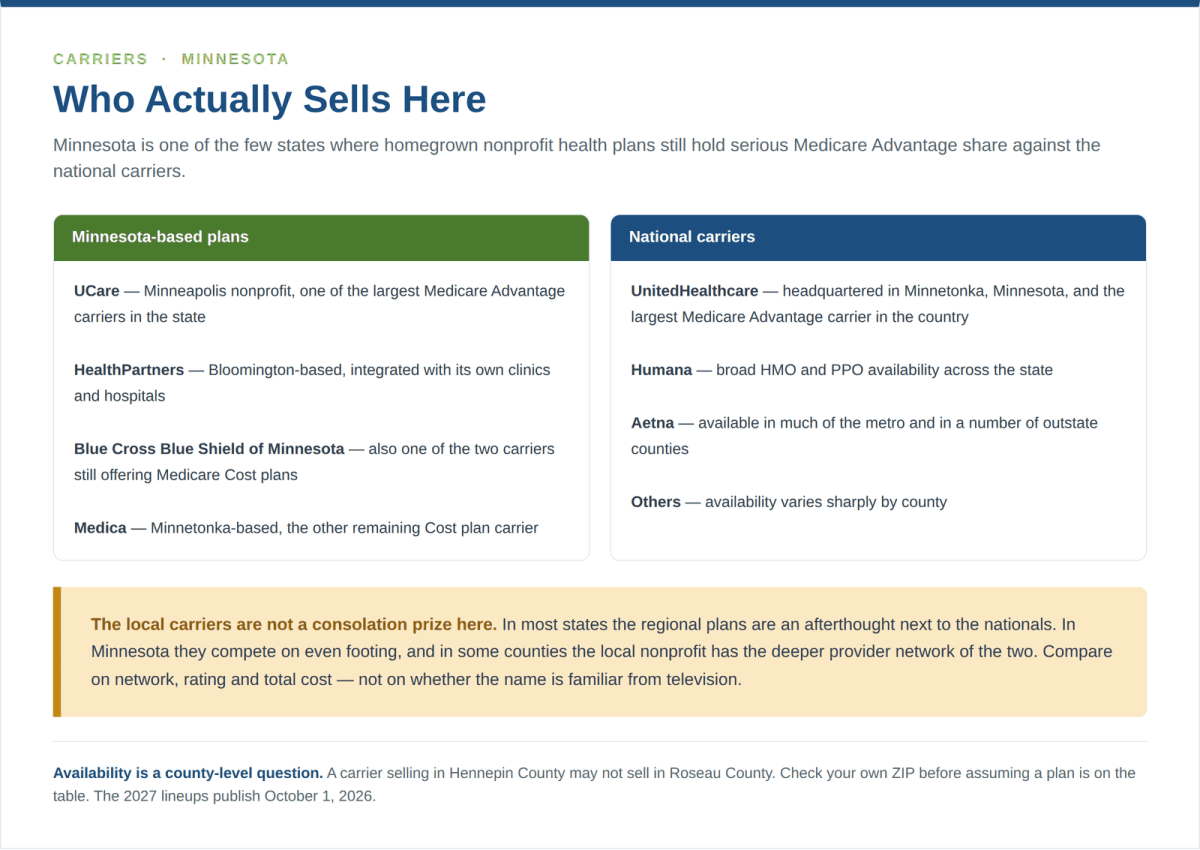
Medicare Advantage carriers in Minnesota including UCare, HealthPartners, Blue Cross Blue Shield of Minnesota, Medica, UnitedHealthcare, Humana and Aetna

Minnesota is one of the few states where homegrown nonprofit health plans still hold serious Medicare Advantage share against the national carriers. UCare, based in Minneapolis, is one of the largest Medicare Advantage carriers in the state. HealthPartners, based in Bloomington, is unusual in that it owns its own clinics and hospitals, so the plan and the care delivery are the same organization. Blue Cross Blue Shield of Minnesota and Medica round out the local group, and both are among the carriers still offering Medicare Cost plans in the counties where those survive.

The national carriers are here too. UnitedHealthcare, Humana and Aetna all sell here, and UnitedHealthcare is in the slightly odd position of being headquartered in Minnetonka while competing against four Minnesota plans in its own backyard. Humana Medicare Advantage plans have broad HMO and PPO availability across the state. Availability for every one of these carriers varies by county, sometimes sharply.

Do not discount the local plans. In most states the regional carriers are an afterthought beside the nationals. In Minnesota they compete on even footing, and in a number of counties the local nonprofit has the deeper provider network of the two — particularly where a health system and a health plan are the same organization. Compare on network, star rating and total annual cost, not on which name you recognize from television.

Minnesota is one of only a handful of states where this happens. Medicare Advantage plans in California are the other clear example, where Kaiser Permanente, SCAN Health Plan and Blue Shield of California compete directly against the national carriers rather than around them.

Ohio is the closest parallel in the region, for a different reason. Its regional carriers are tied directly to hospital systems rather than to insurance history, and the average Ohio beneficiary faces 62 plans against Minnesota’s 19. Our guide to Medicare Advantage plans in Ohio covers how that plays out.

Find & Compare Plans Online

Speak with a licensed insurance agent

1-855-454-9051TTY 711

Mon-Fri: 8am-9pm ET

Minnesota Health Systems and Where to Get Free Local Help

The network question in Minnesota is really a health system question. Most Minnesotans get their care inside one large system, and that system either contracts with a given Medicare Advantage plan for 2027 or it does not. Working backward from the system you already use is faster than working forward from a list of plans.

Region Health systems you are most likely using
Twin Cities metro M Health Fairview, Allina Health, HealthPartners, Hennepin Healthcare, North Memorial Health
Rochester and southeast Mayo Clinic, plus Mayo Clinic Health System locations across southern Minnesota
Duluth and northeast Essentia Health, and the hospitals serving the Iron Range
St. Cloud and central CentraCare
Western Minnesota Sanford Health, alongside independent regional and critical access hospitals

Rural Minnesota deserves a separate check. In counties along the Canadian and Dakota borders, one critical access hospital may be the only realistic option, and the number of Medicare Advantage plans contracting with it can be small. In those counties the choice is frequently between two or three workable plans rather than the statewide average of 19.

Free, unbiased help from the state

Minnesota Aging Pathways — formerly known as the Senior LinkAge Line, and still run by the Minnesota Board on Aging in partnership with the state’s area agencies on aging. Free one-to-one Medicare counseling with no sales interest attached. Call 800-333-2433, Monday through Friday, 8:00 a.m. to 4:30 p.m.

Minnesota Department of Human Services — administers Medical Assistance and Minnesota Senior Health Options (MSHO), the state program that combines Medicare and Medical Assistance coverage into a single plan for people 65 and older who qualify for both. If that describes you, start there before comparing standard Medicare Advantage plans.

Minnesota Department of Commerce — regulates insurance in the state and handles complaints about marketing conduct, including the unsolicited calls that pick up sharply every October.

If you take one thing from this section: call your clinic and ask which 2027 plans they are contracted with before you look at a single premium. In Minnesota that one phone call eliminates most of the field, and it costs nothing.

What Medicare Advantage Plans Cost in Minnesota

The premium is the number people look at and the least useful one. Many Minnesota Medicare Advantage plans carry a $0 monthly plan premium, which tells you almost nothing about what a bad year would actually cost you. Here is the full cost picture and where each piece comes from.

What you pay How it works in Minnesota
$Part B premium You keep paying this to Medicare every month regardless of which Advantage plan you join. Medicare sets the standard amount each year. Some plans offer a partial giveback, but that is plan-specific and not something to count on.
Plan premium Frequently $0 in Minnesota, especially in the metro where competition is heaviest. A $0 premium is a marketing headline, not a measure of value.
+Copays and coinsurance Set per plan and per service. This is where plans genuinely differ — specialist visits, imaging, outpatient surgery and inpatient hospital days are the categories worth comparing line by line.
Out-of-pocket maximum Every Medicare Advantage plan has one, and it is the number that defines your worst case. On a PPO there are two — an in-network limit and a higher combined limit that includes out-of-network care. Compare the limits, not the premiums.
Prescription drugs Most Minnesota Advantage plans include Part D coverage. There is an annual cap on what you pay out of pocket for covered Part D drugs, which Medicare adjusts each year. Your actual cost depends on your specific drugs and their tier.
Out-of-network care On an HMO, generally not covered outside emergencies. On a PPO, covered at a higher cost share. In a state where a meaningful number of people spend months elsewhere, this line deserves more weight than most people give it.

Specific 2027 benefits and cost shares are not final until carriers publish their plan details on October 1, 2026. Extras such as dental, vision, hearing and over-the-counter allowances may be included depending on the plan and the county, and not every plan offers every extra. Treat anything you read about 2027 benefits before October as directional rather than confirmed.

HMO, PPO and the Travel Question

Minnesota is geographically lopsided from a network standpoint. The Twin Cities metro has dense, overlapping provider networks and a lot of plan choice. Greater Minnesota often runs on a single regional health system, which means the practical question is not how many plans exist but which of them actually contracts with the hospital and clinic you already use. In much of the state, network adequacy is the deciding factor and everything else is secondary.

1HMO Plans  ·  Lowest cost, tightest network

HMO plans keep you inside a defined network and often require a referral to see a specialist. They tend to carry the lowest cost shares of any plan type. They are the wrong structure if you spend significant time out of state.

2PPO Plans  ·  More freedom, higher copays

PPO plans cover out-of-network care at a higher cost share and usually skip the referral requirement. For snowbirds and for people who split time between a lake place and the metro, the flexibility is often worth the higher copays.

3Special Needs Plans  ·  Strict eligibility, richer benefits

Special Needs Plans are built for people who have both Medicare and Medical Assistance, or who have a qualifying chronic condition. Minnesota has a substantial dual-eligible population and these plans are widely available across the state, but the eligibility rules are strict and you must continue to qualify to stay enrolled.

If You Are Weighing Original Medicare Instead

Medicare Advantage is not the only route, and in a state with this much Cost plan history the alternative deserves a fair hearing. The basic trade is the same everywhere: Original Medicare gives you nationwide access to any provider who takes Medicare and no network to manage, while Medicare Advantage bundles everything into one plan with a network and an out-of-pocket ceiling. Our full breakdown of Original Medicare and Medicare Advantage walks through where each one wins.

One Minnesota-specific wrinkle is worth knowing. Minnesota is one of only three states operating under a federal waiver for Medicare Supplement insurance, so instead of the standardized Plans A through N sold everywhere else, Minnesota has its own plan designs — Basic, Extended Basic and Medicare SELECT. Minnesota also prohibits pricing those policies by age. If you are comparing the two paths, our page on Medigap and Medicare Advantage side by side covers the general trade-offs, but confirm the Minnesota-specific plan designs with a licensed agent before you assume the national rules apply to you.

When You Can Enroll for 2027

Minnesota follows the federal Medicare calendar. The Annual Enrollment Period runs October 15 through December 7, 2026, and anything you choose in that window takes effect January 1, 2027. This is the only period in which anyone can join, switch or drop a Medicare Advantage plan freely, and it is the window that matters most.

Window Dates What you can do
Annual Enrollment Period Oct 15 – Dec 7, 2026 Join, switch or drop a Medicare Advantage plan. Change Part D plans. Coverage starts January 1, 2027.
Medicare Advantage Open Enrollment Jan 1 – Mar 31, 2027 Only if you are already in a Medicare Advantage plan. One change — switch plans or return to Original Medicare. You cannot use it to join Advantage from Original Medicare.
Initial Enrollment Period 7 months around your 65th birthday Your first chance to enroll. Starts three months before your birthday month and ends three months after.
Special Enrollment Periods Triggered by an event Moving out of your plan’s service area, losing employer coverage, qualifying for Medical Assistance, or your plan leaving your county.

The trap for former Cost plan members. The Medicare Advantage Open Enrollment Period in January through March gives you exactly one change, and once you use it you are locked in until the next Annual Enrollment Period. It is not the year-round flexibility a Cost plan gave you, and assuming otherwise is how people end up stuck for a year in a plan that does not cover their doctor.

Medicare Annual Enrollment Period timeline for 2027 coverage: Annual Notice of Change arrives in September, 2027 plan details publish October 1, enrollment opens October 15 and closes December 7

How to Compare Minnesota Plans for 2027

Step 1

Start with your ZIP code, not the carrier

A plan available in Hennepin County may not be sold in Roseau County, and the same carrier can have entirely different networks and cost shares in the two. Every comparison starts at the county level. The statewide average of 19 plans is context, not a menu.

Step 2

Check your clinic and health system, then confirm it

Look up each doctor in the plan’s 2027 directory, then call the clinic and ask directly. Networks are renegotiated every year and online directories lag behind. In greater Minnesota, where one health system may be the only realistic option, this single check decides the plan.

Step 3

Run your actual prescriptions

Not a general sense of whether the plan has good drug coverage. Every medication, against the plan’s 2027 formulary, checking the tier and whether it requires prior authorization. Drug costs are the most common source of an unpleasant surprise in February.

Step 4

Answer the travel question honestly

If you spend two or three months a year out of state, an HMO will not serve you the way a Cost plan did. Routine care in Arizona is not an emergency, and an HMO will not pay for it. This is the most common mismatch in the Minnesota market.

Step 5

Compare the out-of-pocket maximum, not the premium

A $0 premium plan with a high ceiling can cost far more in a bad year than a plan charging $40 a month. Look at the in-network limit and, on a PPO, the combined limit too. That pair of numbers is your real financial exposure.

Compare Medicare plans in Minnesota

Frequently Asked Questions

  Who has the best Medicare Advantage plan in Minnesota?

There is no single best plan in Minnesota, and any page that names one is guessing at your situation. Star ratings are assigned per contract rather than per company, so a carrier with a strong statewide reputation can still have a weaker plan in your county and the reverse is equally common. Minnesota is also one of the few states where the local nonprofit plans — UCare, HealthPartners, Blue Cross Blue Shield of Minnesota and Medica — compete on even footing with UnitedHealthcare, Humana and Aetna, so the strongest option in Hennepin County may not be the strongest in Beltrami. The best plan for you is the one that covers your doctors, covers your prescriptions at a reasonable tier, and has an out-of-pocket maximum you could absorb in a bad year.

  What Medicare Advantage plans are leaving Minnesota?

Nobody can answer this at a county level yet, and be skeptical of any site that claims to. Several carriers have announced national reductions for 2027 — Humana has said plans covering roughly 600,000 members will not be offered — but those announcements give member totals, not plan-by-plan or county-by-county lists. The two documents that will actually answer it for Minnesota are the non-renewal notice your carrier must mail by October 1, 2026, and the full 2027 plan data that publishes the same day. If your plan is discontinued you may also qualify for a Special Enrollment Period that extends your window past December 7.

  What will happen to Medicare Advantage plans in 2027?

The industry is contracting rather than expanding for 2027. Multiple carriers have signalled they will exit counties, discontinue lower-rated contracts and adjust supplemental benefits, with dental, vision, hearing and over-the-counter allowances the categories most commonly trimmed across the industry. What is already confirmed at the federal level applies to every plan regardless of carrier: the Medicare Advantage out-of-pocket maximum and the annual Part D out-of-pocket cap are set nationally. What is not confirmed is any individual plan’s premium, copays, network or benefit package — all of that publishes October 1, 2026. Treat any specific 2027 figure quoted before that date as an estimate.

  Why do people say to stay away from Medicare Advantage plans?

The criticisms are real and worth understanding rather than dismissing. Medicare Advantage plans use networks, so the doctor you want may not be covered. Many require prior authorization for procedures Original Medicare would simply pay. Costs arrive as copays during a bad health year rather than as a predictable monthly premium. And the decision is harder to reverse than to make — going back to Original Medicare with a supplement later usually means answering health questions and being subject to underwriting. The counterargument is equally real: every Medicare Advantage plan caps your annual out-of-pocket spending, which Original Medicare alone does not, and many carry no additional premium. In Minnesota this trade-off deserves extra thought, because so many members arrived from Medicare Cost plans that behaved very differently on networks and travel.

  How many Medicare Advantage plans are available in Minnesota?

The average Minnesota county has around 19 Medicare Advantage plans available. That number is much higher in the Twin Cities metro and considerably lower in rural counties in the north and west. Because availability is set at the county level, the only figure that matters to you is how many plans are sold in your own ZIP code.

  Are Medicare Cost plans still available in Minnesota?

Yes, but only in 21 counties, and only through Blue Cross Blue Shield of Minnesota and Medica. Federal law required Cost plans to end in counties where enough Medicare Advantage competition existed, which eliminated them in 66 Minnesota counties at the end of 2018. Statewide enrollment fell from more than 40% of Medicare beneficiaries to roughly 6%.

  Which companies offer Medicare Advantage plans in Minnesota?

Minnesota-based carriers include UCare, HealthPartners, Blue Cross Blue Shield of Minnesota and Medica. National carriers selling here include UnitedHealthcare, which is headquartered in Minnetonka, along with Humana and Aetna. Minnesota is unusual in that the local nonprofit plans compete on genuinely even footing with the national carriers rather than being a secondary option.

  Do Medicare Advantage plans in Minnesota cover me when I travel?

Emergency and urgently needed care is covered anywhere in the United States on any Medicare Advantage plan. Routine care is a different matter. On an HMO, routine care outside the network is generally not covered at all. On a PPO, it is covered at a higher cost share. If you winter out of state, this is the single most important thing to check before enrolling, and it is where former Cost plan members are most often caught out.

  Why are Medicare Supplement plans different in Minnesota?

Minnesota is one of three states operating under a federal waiver, so it uses its own supplement plan designs — Basic, Extended Basic and Medicare SELECT — rather than the standardized Plans A through N sold in most of the country. Minnesota also prohibits pricing these policies based on age. If you are weighing a supplement against a Medicare Advantage plan, confirm the Minnesota-specific designs with a licensed agent rather than relying on national comparisons.

  When can I enroll in a 2027 Medicare Advantage plan in Minnesota?

The Annual Enrollment Period runs October 15 through December 7, 2026, with coverage beginning January 1, 2027. If you are already in a Medicare Advantage plan, the Medicare Advantage Open Enrollment Period from January 1 to March 31, 2027 gives you one additional change. Turning 65 or experiencing a qualifying event such as a move or a loss of employer coverage opens its own enrollment window.

  When will 2027 Minnesota plan details be available?

Carriers publish their 2027 plan details on October 1, 2026, two weeks before the Annual Enrollment Period opens. Premiums, copays, networks, formularies and extra benefits are not final before that date. Anything published about 2027 benefits ahead of October 1 should be treated as directional rather than confirmed, and extras such as dental, vision and hearing may or may not be included depending on the plan and county.

Have Questions?

Speak with a licensed insurance agent

1-855-454-9051

TTY users 711

Mon-Fri: 8am-9pm ET

Find & Compare Plans Online

Speak with a licensed insurance agent

1-855-454-9051TTY 711

Mon-Fri: 8am-9pm ET

ZRN Health & Financial Services, LLC, a Texas limited liability company