Speak with a licensed insurance agent

1-855-454-9051

TTY user 711 Mon-Fri : 8am-9pm EST

Medicare Advantage Plans in Ohio 2027: Costs, Carriers and Coverage

Reviewed by Russell Noga, Licensed Medicare Insurance Broker (all 50 states) — Last updated September 11, 2026

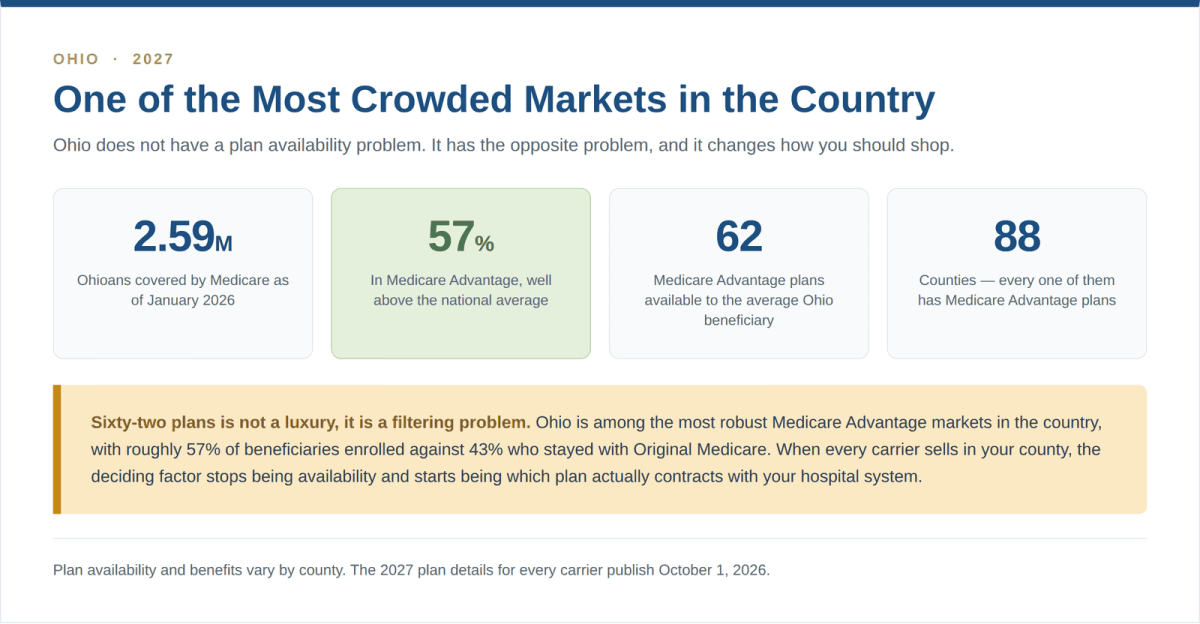
Ohio does not have a Medicare Advantage availability problem. It has the opposite problem. Roughly 2.59 million Ohioans are on Medicare, about 57% of them are enrolled in a Medicare Advantage plan, and the average beneficiary can choose from around 62 of them — one of the most crowded markets in the country. Every one of Ohio’s 88 counties has plans available.

That abundance changes what you should actually be doing. When every national carrier sells in your county, and a handful of Ohio-only regional plans sell there too, availability stops being the question. The question becomes which of those 62 plans contracts with your hospital system, covers your prescriptions, and will still exist in January.

This page covers the 2027 Ohio market: who sells where, what plans cost, a gap in Ohio law that affects 270,000 people and almost nobody writes about, and how to narrow the field down to one. For the national picture first, see our overview of Medicare Advantage plans for 2027.

Ohio Medicare market overview showing 2.59 million beneficiaries, 57 percent in Medicare Advantage and 62 plans available on average

Compare Medicare Plans in Ohio for 2027

Medicare Advantage in Ohio at a Glance

Sixty-two plans sounds like an embarrassment of riches until you try to compare them. Ohio sits well above the national average on Medicare Advantage take-up, with 57% enrolled against 43% who stayed with Original Medicare, and the competition is genuine — national carriers and Ohio-based regional plans fighting for the same members in the same counties. The practical effect is that a recommendation from a neighbor two counties over is worth very little.

Three things that make Ohio different

1. Regional carriers tied to hospital systems. Ohio has an unusually deep bench of local plans, each built around a specific health system in a specific metro.

2. Plan volume that works against you. 62 plans on average means more choice and more chance of choosing badly. Filtering matters more here than in thin markets.

3. No Medicare Supplement under 65. Ohio is one of only four states where no insurer will sell a supplement to a beneficiary under 65. That reshapes the decision for 270,000 people.

Every Ohio beneficiary pays the standard Medicare Part B premium before any plan premium is added on top, and that figure is rising again. The 2026 premium is $202.90 a month with a $283 annual deductible, and early projections put 2027 higher still. Our breakdown of what Part B costs in 2027 covers the projected premium, the deductible, the IRMAA income brackets, and which plans credit part of that premium back to you.

If You Are Under 65 and on Medicare in Ohio

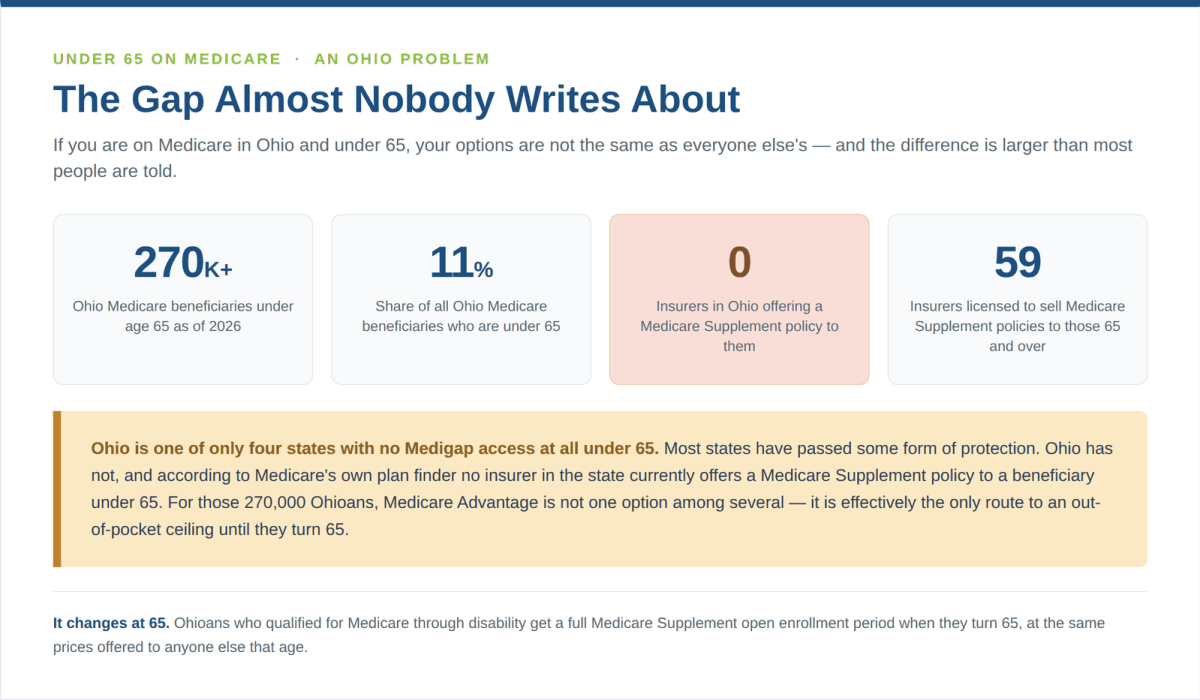
Ohio has more than 270,000 Medicare beneficiaries under age 65 and no insurer offering them a Medicare Supplement policy

This section applies to roughly one in nine Ohio Medicare beneficiaries, and it is the single most consequential thing on this page for them. Almost 11% of Ohioans on Medicare are under 65 — more than 270,000 people who qualified through disability rather than age. Most guides treat them as a footnote. In Ohio they deserve the opposite.

Ohio has not legislated Medigap access for people under 65. Most states have addressed this in some form. Ohio is one of only four that have not, and according to Medicare’s own plan finder, no insurer in Ohio currently offers a Medicare Supplement policy to a beneficiary under 65 — at any price. Fifty-nine insurers are licensed to sell those policies in Ohio. None of them will sell you one before your 65th birthday.

The consequence is straightforward. Original Medicare on its own has no cap on what you can spend in a year. For an Ohioan under 65, the usual fix — pairing Original Medicare with a supplement — is not available. That leaves Medicare Advantage as the practical route to an out-of-pocket ceiling, which makes the plan comparison on this page less of an optimization exercise and more of a necessity. Our breakdown of Original Medicare and Medicare Advantage covers what each structure actually costs.

It does change at 65. Ohioans who came onto Medicare through disability get a full Medicare Supplement open enrollment period when they turn 65, and can buy any plan available at the same price offered to anyone else that age. If you are approaching 65 on a Medicare Advantage plan, that birthday is a real decision point worth preparing for in advance rather than discovering afterward. Our comparison of Medigap and Medicare Advantage covers the trade-off.

Which Companies Sell Medicare Advantage Plans in Ohio

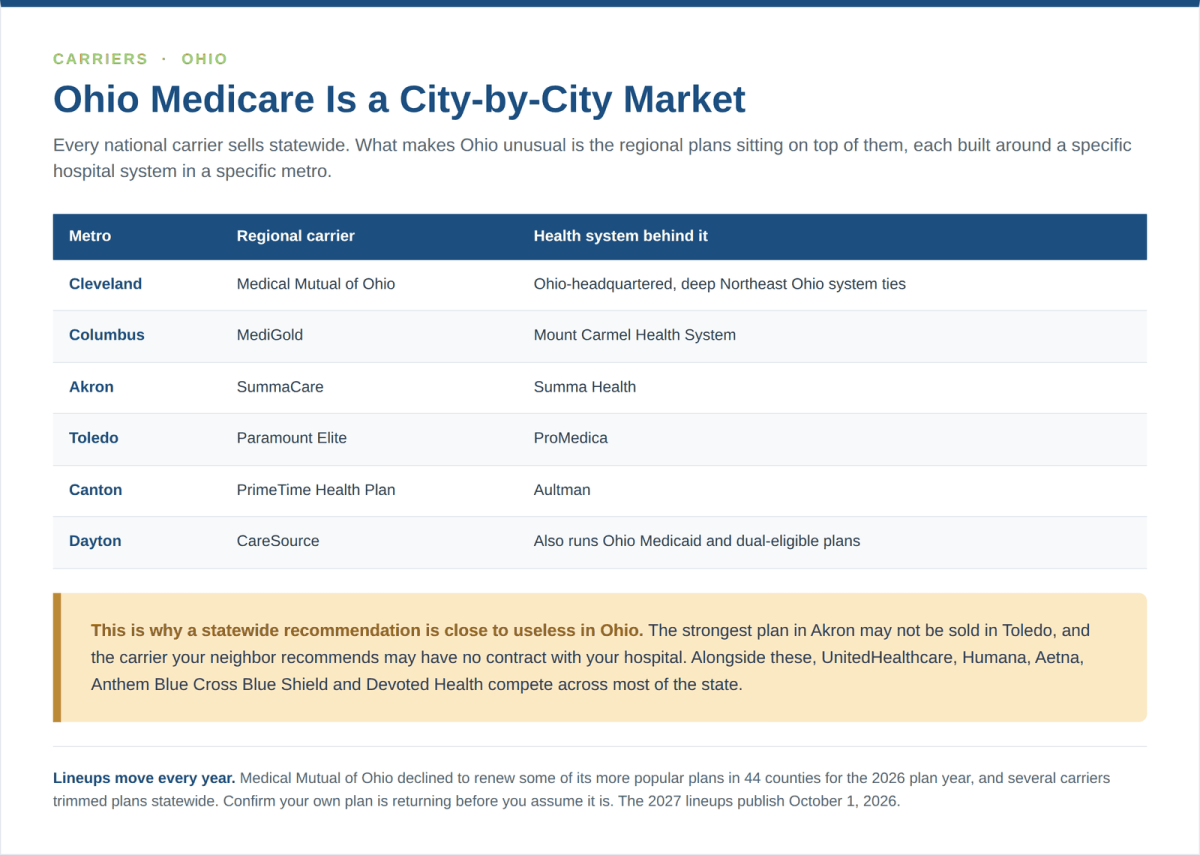
Ohio Medicare Advantage regional carriers by metro including Medical Mutual of Ohio, MediGold, SummaCare, Paramount Elite, PrimeTime Health Plan and CareSource

Every national carrier competes in Ohio. Humana, UnitedHealthcare, Aetna, Anthem Blue Cross Blue Shield and Devoted Health all sell across most of the state. What makes Ohio distinctive is what sits on top of them: a set of regional carriers that exist nowhere else, each built around the health system that dominates its metro.

Metro Regional carrier The system behind it
Cleveland Medical Mutual of Ohio Ohio-headquartered, with deep Northeast Ohio health system relationships
Columbus MediGold Mount Carmel Health System
Akron SummaCare Summa Health, with a strong network in Summit and surrounding counties
Toledo Paramount Elite ProMedica, which anchors the Paramount network in the Toledo region
Canton PrimeTime Health Plan Aultman
Dayton CareSource Also runs Ohio Medicaid and dual-eligible plans, which matters if you qualify for both

Lineups move, sometimes sharply. Medical Mutual of Ohio declined to renew some of its more popular plans across 44 counties for the 2026 plan year, and several other carriers trimmed their Ohio offerings at the same time. More reductions have been signaled industry-wide for 2027. Do not assume the plan you are in now is returning — your carrier must tell you in writing by October 1, 2026 if it is not.

Find & Compare Plans Online

Speak with a licensed insurance agent

1-855-454-9051TTY 711

Mon-Fri: 8am-9pm ET

What Medicare Advantage Plans Cost in Ohio

Premiums in Ohio run low by national standards, which is what heavy competition does. It is also the least useful thing to compare. Here is the full cost picture.

What you pay How it works in Ohio
$Part B premium Paid to Medicare monthly regardless of which Advantage plan you join. Medicare sets the standard amount each year. Some Ohio plans offer a partial giveback, which is plan-specific and should not be assumed.
Plan premium Frequently $0 in Ohio, and average premiums here run low because competition is fierce. A $0 premium is a marketing headline, not a measure of value.
+Copays and coinsurance Set per plan and per service. With 62 plans to compare, this is where the meaningful differences hide — specialist visits, imaging, outpatient surgery and inpatient hospital days.
Out-of-pocket maximum Every plan has one, and it defines your worst case. PPOs have two — an in-network limit and a higher combined limit. For anyone under 65 in Ohio, this cap is the entire reason to be in a Medicare Advantage plan.
Prescription drugs Most Ohio Advantage plans bundle Part D. There is an annual cap on out-of-pocket costs for covered Part D drugs, which Medicare adjusts each year. Your real cost depends on your specific medications and their tiers.
Out-of-network care Generally not covered on an HMO outside emergencies, covered at a higher share on a PPO. In Ohio this often means care at a hospital system your regional carrier does not contract with.

Specific 2027 premiums, copays and benefits are not final until carriers publish plan data on October 1, 2026. Extras such as dental, vision, hearing and over-the-counter allowances may be included depending on the plan and the county, and not every plan offers every extra. Treat anything quoted about 2027 benefits before October as directional rather than confirmed.

What Changes From One Ohio Metro to the Next

Ohio has six substantial metros and a large rural remainder, and the Medicare Advantage market looks different in each. In Cleveland and Akron, the question is usually which plans contract with the Northeast Ohio health systems you already use. In Columbus, Mount Carmel’s own plan competes directly against the nationals. In Toledo, ProMedica’s reach shapes the network map. In Cincinnati and Dayton, the mix leans differently again, and CareSource’s Medicaid footprint matters for anyone who qualifies for both programs.

Start from the hospital, not the plan. In most states you pick a plan and then check the network. In Ohio the reverse is faster. Decide which health system you want to keep using, find out which plans it contracts with for 2027, and you will have cut 62 options down to a handful before you look at a single premium.

Other large states solve the same problem differently. Medicare Advantage plans in California face an even wider spread — more than a hundred plans in Los Angeles County down to none at all in two counties — while Medicare Advantage plans in Minnesota run on a much smaller menu of about 19 per county, shaped by a product called the Medicare Cost plan that dominated that state until 2018. Ohio sits at the crowded end of that range, which is why filtering matters more here than choosing.

HMO, PPO and Special Needs Plans in Ohio

1HMO Plans  ·  Lowest cost, tightest network

The structure most Ohio regional carriers use, because their value proposition is a specific hospital system. You stay in-network and usually need a referral for a specialist, in exchange for the lowest cost shares available. Wrong choice if you spend winters elsewhere or split time across state lines.

2PPO Plans  ·  More freedom, higher copays

Out-of-network care covered at a higher cost share, referrals generally not required. Usually the national carriers rather than the regionals. Worth the higher copays if you use doctors across more than one Ohio health system, or travel regularly.

3Special Needs Plans  ·  Strict eligibility, deeper coordination

For people with both Medicare and Ohio Medicaid, or with a qualifying chronic condition. Ohio has a substantial dual-eligible population and several carriers run integrated plans covering both programs, which is worth investigating first if you qualify. Eligibility rules are strict and you must continue to qualify to stay enrolled.

When You Can Enroll for 2027

Ohio follows the federal Medicare calendar. The Annual Enrollment Period runs October 15 through December 7, 2026, and whatever you choose takes effect January 1, 2027. That is the only window in which anyone can join, switch or drop a Medicare Advantage plan freely.

Window Dates What you can do
Annual Enrollment Period Oct 15 – Dec 7, 2026 Join, switch or drop a Medicare Advantage plan. Change Part D plans. Coverage starts January 1, 2027.
Medicare Advantage Open Enrollment Jan 1 – Mar 31, 2027 Only if you are already in a Medicare Advantage plan. One change, then you are locked in until the next AEP.
Initial Enrollment Period 7 months around your 65th birthday Starts three months before your birthday month and ends three months after. In Ohio this is also when Medicare Supplement access opens for the first time.
Special Enrollment Periods Triggered by an event Moving out of your plan’s service area, losing employer coverage, qualifying for Ohio Medicaid, or your plan leaving your county.

The January window is narrower than most people assume. The Medicare Advantage Open Enrollment Period gives you exactly one change, and it cannot be used to join Medicare Advantage from Original Medicare.

How to Narrow 62 Plans Down to One

Step 1

Pick your hospital system first

This is the Ohio-specific move and it does more work than anything else on this list. Decide which health system you intend to keep using, find out which plans contract with it for 2027, and most of the 62 options disappear immediately.

Step 2

Confirm each doctor by phone

Look every physician up in the plan’s 2027 directory, then call the practice and ask directly. Directories lag behind contract changes, and in a market where carriers renegotiate with systems annually, that lag costs people their doctors.

Step 3

Run your actual prescriptions

Every medication against the plan’s 2027 formulary, checking the tier and whether it requires prior authorization. Formularies are rebuilt annually and drug costs are the most common February surprise.

Step 4

Check the rating on the contract, not the company

CMS rates individual contracts, so a carrier’s national average says little about the plan in front of you — and Ohio’s regional carriers are rated entirely separately from the nationals. Our guide to top rated Medicare Advantage plans explains how to read them. The 2027 ratings publish October 2026.

Step 5

Compare the out-of-pocket maximum, not the premium

A $0 premium plan with a high ceiling can cost far more in a bad year than one charging a modest monthly amount. Compare the in-network limit and, on a PPO, the combined limit. Those two numbers are your real exposure.

Compare Medicare Plans in Ohio for 2027

Frequently Asked Questions

  Who has the best Medicare Advantage plan in Ohio?

There is no statewide answer, and in Ohio that is more true than in most states. The average beneficiary chooses among roughly 62 plans, and the regional carriers — Medical Mutual of Ohio, MediGold, SummaCare, Paramount Elite, PrimeTime Health Plan, CareSource — are each built around a different hospital system in a different metro. A plan that is excellent in Akron may not be sold in Toledo. Star ratings are assigned per contract rather than per company, so the useful comparison is between the specific plans offered in your county. The best plan for you is the one that contracts with your hospital, covers your prescriptions at a workable tier, and caps your annual spending at a number you could absorb.

  What is the biggest disadvantage of the Medicare Advantage plan?

The network. Every other drawback follows from it. Medicare Advantage plans cover care through a defined set of doctors and hospitals, which means your choice is narrower than Original Medicare and can change when a carrier and a health system fail to agree on terms. Prior authorization requirements are the second complaint, and the third is that the decision is harder to reverse than to make — leaving Medicare Advantage for Original Medicare with a supplement later usually means medical underwriting. In Ohio that last point has an extra edge: if you are under 65, no insurer in the state will sell you a supplement at all.

  What are the top three Medicare Advantage plans?

Rankings of this kind are built on national averages and they do not survive contact with a specific ZIP code. CMS rates individual contracts, not companies, and a carrier with a strong national average can offer a weak plan in your county while a smaller regional carrier offers an excellent one. In Ohio the regional plans are rated entirely separately from the national carriers, which makes national top-three lists particularly unhelpful here. Compare the specific contracts available where you live, using the 2027 star ratings when they publish in October 2026.

  What is the most accepted Medicare Advantage plan in Ohio?

Acceptance is a local question, not a national one. The national carriers — UnitedHealthcare, Humana, Aetna and Anthem Blue Cross Blue Shield — generally contract with the widest range of providers across Ohio as a whole. But within a given metro, the regional carrier tied to the dominant health system is often the one most readily accepted at that system’s hospitals and clinics. SummaCare at Summa Health in Akron and Paramount Elite at ProMedica in Toledo are clear examples. Ask your own doctor’s office which plans they take for 2027 rather than relying on a general answer.

  Can you get a Medicare Supplement in Ohio if you are under 65?

No. Ohio is one of only four states that have not legislated Medicare Supplement access for beneficiaries under 65, and according to Medicare’s plan finder no insurer in Ohio currently offers one to that group. This affects more than 270,000 Ohioans, roughly 11% of the state’s Medicare population. Because Original Medicare alone has no annual out-of-pocket cap, a Medicare Advantage plan is the practical route to a spending ceiling until you turn 65. At 65 the situation changes completely: you get a full Medicare Supplement open enrollment period at the same prices offered to anyone else that age.

  How many Medicare Advantage plans are available in Ohio?

The average Ohio Medicare beneficiary can choose from around 62 Medicare Advantage plans for 2026, which puts Ohio among the most robust Medicare Advantage markets in the country. Plans are available in all 88 Ohio counties. The count varies by county, with the large metros offering considerably more than rural areas, but unlike some states there is nowhere in Ohio without a Medicare Advantage option.

  Which Ohio-based companies sell Medicare Advantage plans?

Ohio has an unusually deep bench of regional carriers, most of them tied to a health system. Medical Mutual of Ohio is headquartered in Cleveland with strong Northeast Ohio relationships. MediGold operates through Mount Carmel in Columbus. SummaCare is built around Summa Health in Akron. Paramount Elite runs on the ProMedica network in Toledo. PrimeTime Health Plan is tied to Aultman in Canton. CareSource, based in Dayton, also administers Ohio Medicaid and dual-eligible plans. These compete directly against UnitedHealthcare, Humana, Aetna, Anthem Blue Cross Blue Shield and Devoted Health.

  When will 2027 Ohio plan details be available?

Carriers publish 2027 plan details on October 1, 2026, two weeks before Annual Enrollment opens. Premiums, copays, networks, formularies and supplemental benefits are not final before that date. This matters more in Ohio than usual right now: Medical Mutual of Ohio declined to renew some popular plans across 44 counties for 2026, and further industry-wide reductions have been signaled for 2027. If your plan is not returning, your carrier must notify you in writing by October 1, 2026.

Have Questions?

Speak with a licensed insurance agent

1-855-454-9051

TTY users 711

Mon-Fri: 8am-9pm ET

Find & Compare Plans Online

Speak with a licensed insurance agent

1-855-454-9051TTY 711

Mon-Fri: 8am-9pm ET

ZRN Health & Financial Services, LLC, a Texas limited liability company