





Speak with a licensed insurance agent

1-855-454-9051

TTY user 711 Mon-Fri : 8am-9pm EST

Medicare Advantage Plans Changes 2027

Reviewed by Russell Noga, Licensed Medicare Insurance Broker (all 50 states) — Last updated September 17, 2026

CMS finalized the 2027 Medicare Advantage rules on April 6, 2026. Most of what you will read about 2027 changes is guesswork about what carriers might do in October. This page separates the two: what is already confirmed in federal rulemaking, and what is still a carrier decision you will not see until plan details go public on October 1.

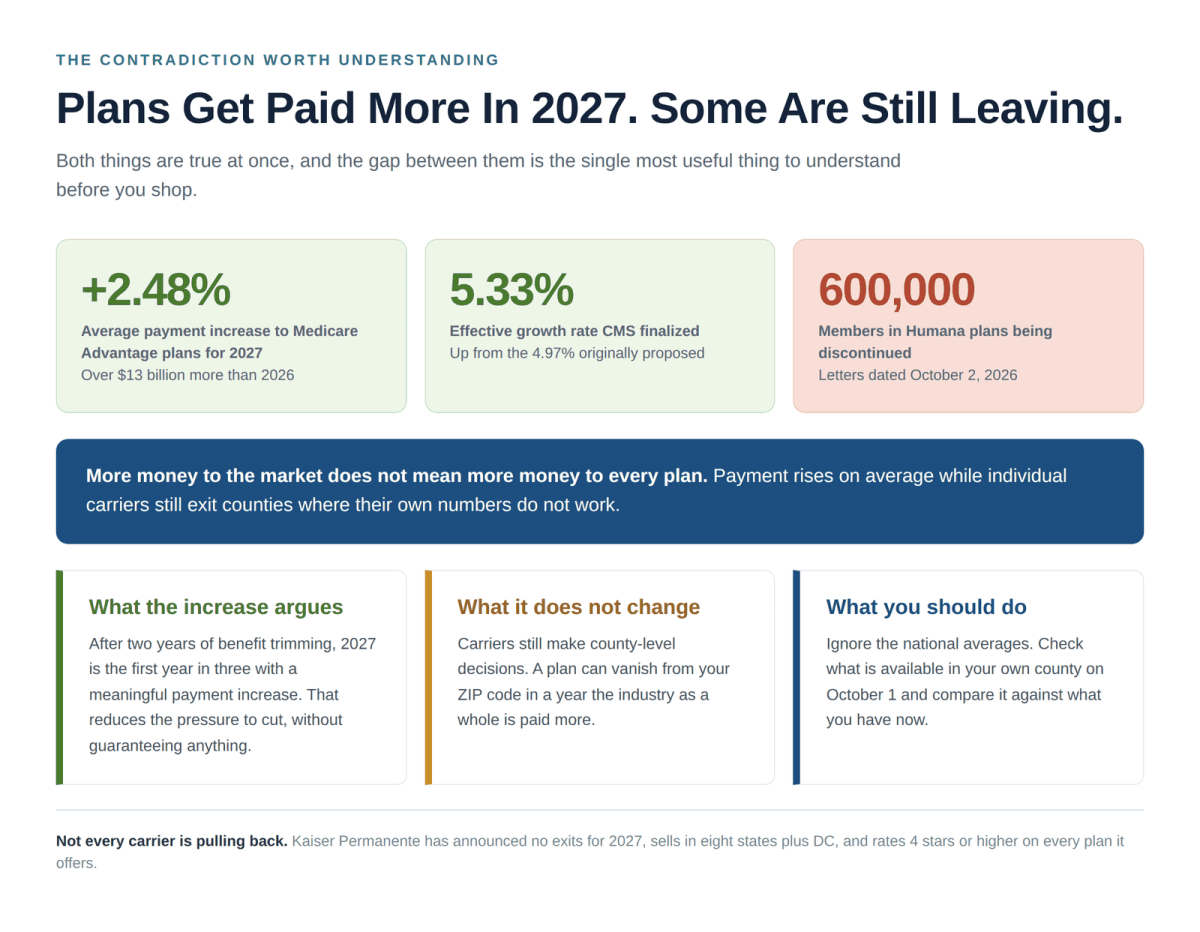
The headline is not what most coverage suggests. Medicare Advantage plans are being paid 2.48% more in 2027 — over $13 billion above 2026 — after two years of trimmed benefits. And Humana is still discontinuing plans covering roughly 600,000 members. Both are true, and understanding why matters more than any single benefit change.

Key Takeaways

  • CMS finalized a 2.48% average payment increase to Medicare Advantage plans for 2027, worth over $13 billion.
  • Humana is discontinuing plans covering roughly 600,000 members, with non-renewal letters dated October 2, 2026.
  • You can no longer self-certify for special supplemental benefits for the chronically ill. Plans must publish objective eligibility criteria.
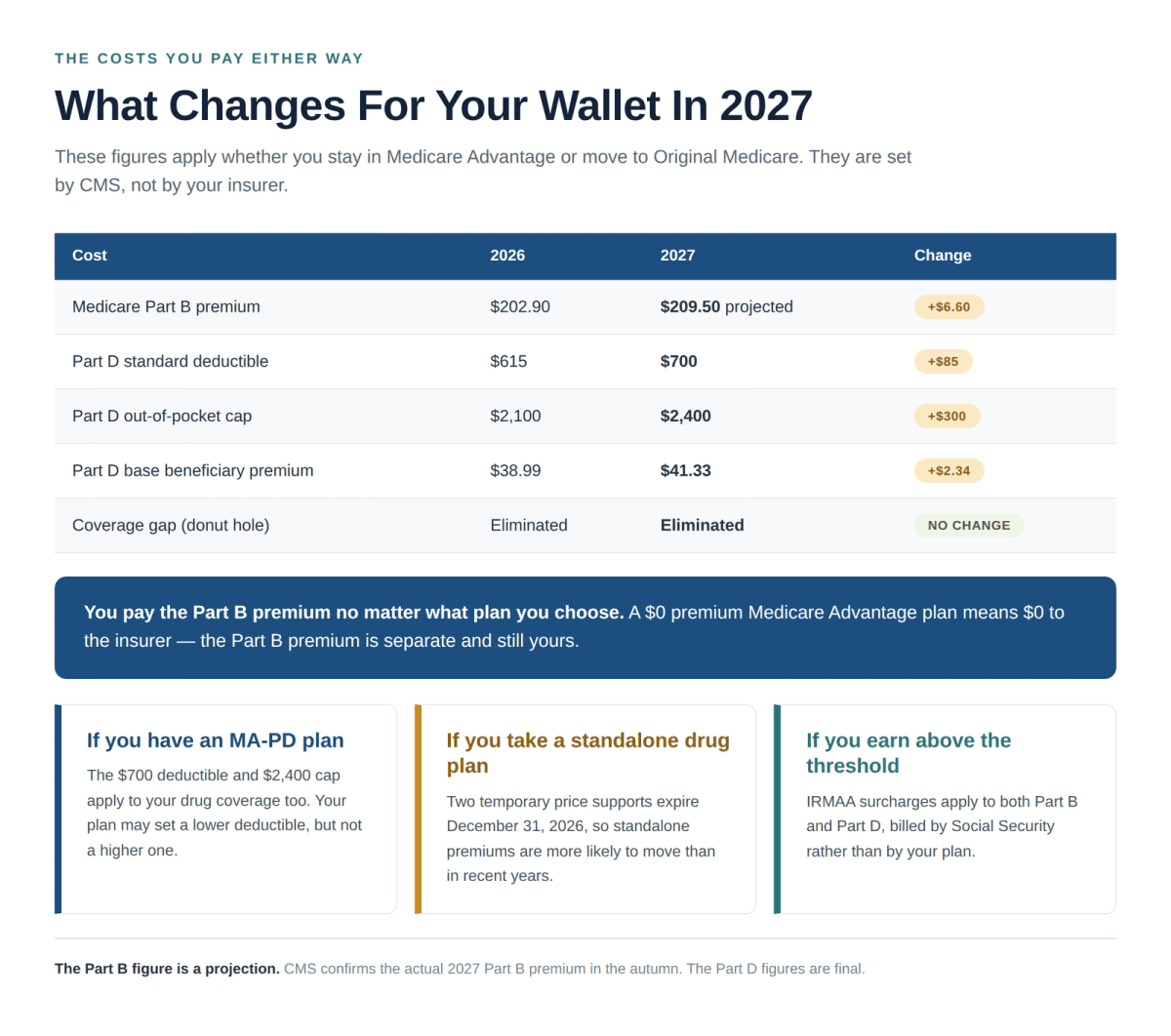
  • The Part D deductible rises to $700 and the out-of-pocket cap to $2,400, which applies to Medicare Advantage drug coverage too.
  • Star Ratings methodology is largely unchanged for 2027. The 11 measure removals start with the 2028 and 2029 ratings.
  • Plan-specific 2027 details are not public until October 1, 2026. Enrollment runs October 15 to December 7.
Confirmed Medicare Advantage plans changes for 2027 finalized by CMS

Compare 2027 plans and enroll online

What Is Confirmed for 2027

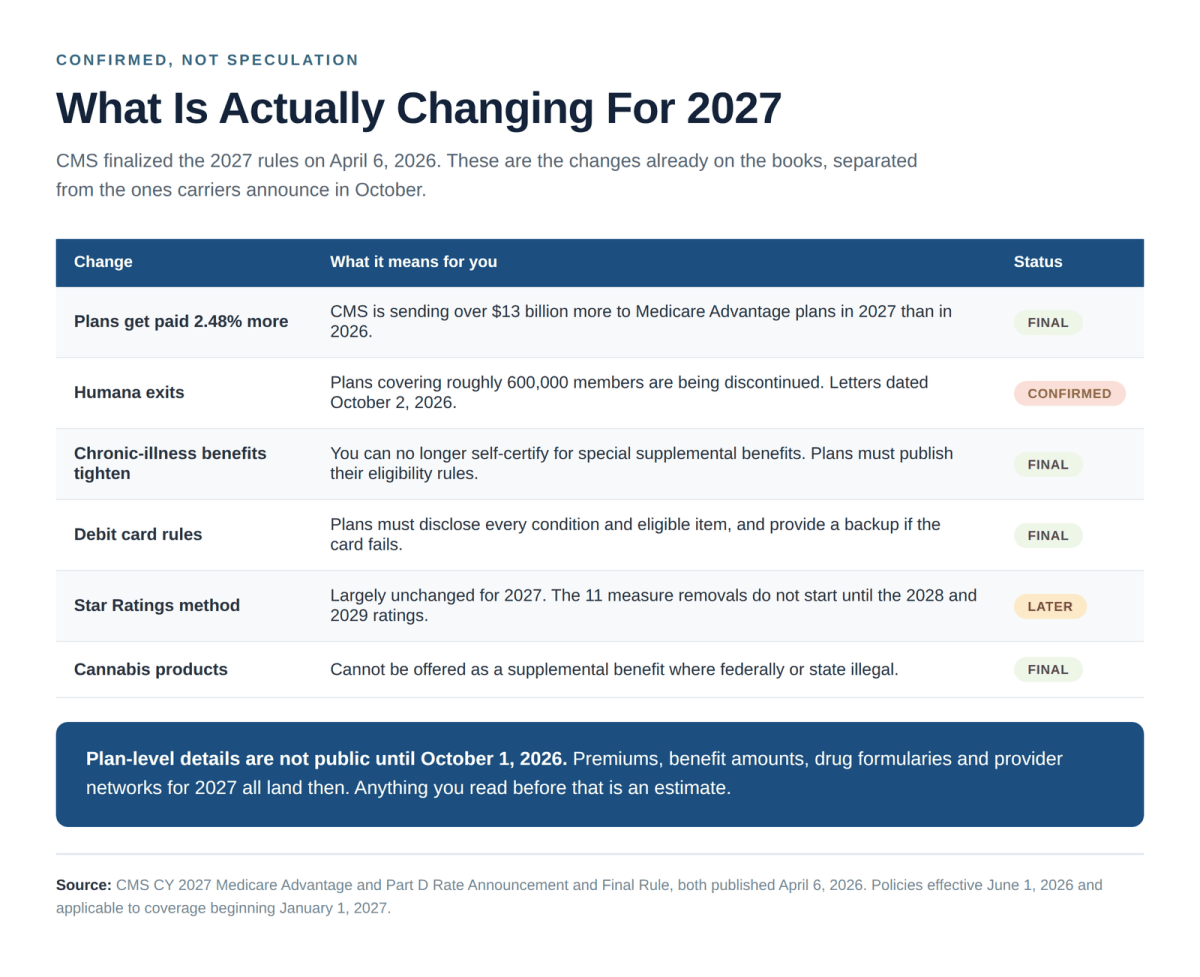
CMS published the CY 2027 Rate Announcement and the CY 2027 Final Rule on the same day, April 6, 2026. Policies took effect June 1, 2026 and apply to coverage beginning January 1, 2027. Everything in the table below is settled federal policy, not a forecast.

Change What it means for you
Plans paid 2.48% more Over $13 billion more flows to Medicare Advantage plans in 2027 than in 2026. The effective growth rate CMS finalized was 5.33%, up from the 4.97% originally proposed.
Humana plan exits Plans covering roughly 600,000 members are being discontinued, with letters dated October 2, 2026 and coverage ending December 31.
Chronic-illness benefits tighten Self-attestation is out. Plans must use objective criteria for special supplemental benefits for the chronically ill and must publicly post those criteria.
Debit card rules Plans issuing benefit debit cards must disclose every condition and eligible item, and must keep an alternative reimbursement route if the card fails.
Star Ratings method Largely unchanged for 2027. Eleven measures are being removed, but not until the 2028 and 2029 ratings. A depression screening measure is added for 2029.
Cannabis excluded Cannabis products illegal under federal or applicable state law cannot be offered as a supplemental benefit. Compliant hemp-derived products remain permissible.

What is not confirmed yet

Individual plan premiums, deductibles, supplemental benefit amounts, provider networks and drug formularies for 2027 are all carrier decisions and none of them are public until October 1, 2026. Specific 2027 benefits depend on the plan and your area, and not every plan offers every benefit. Treat anything you read about a particular plan before October 1 as an estimate.

Medicare Advantage plans get a 2.48% payment increase for 2027 while Humana exits 600,000 members

Why Plans Get Paid More and Some Still Leave

The 2.48% increase is a national average across the whole Medicare Advantage market. It is not a payment to your plan, in your county, for your risk profile. Carriers make county-level decisions on their own numbers, and a plan can disappear from your ZIP code in a year the industry as a whole is paid more.

What the increase does tell you is that the squeeze of the last two years has eased. The 2027 figure came in well above the 0.09% CMS originally proposed in its Advance Notice, revised upward after CMS incorporated newer Original Medicare cost data through the fourth quarter of 2025. Plans entered the 2027 bidding cycle with more room than they had for 2026 or 2025.

What this argues for 2027

Less pressure to cut supplemental benefits than in the last two cycles. It is not a guarantee — carriers may still trim dental, vision, hearing or over-the-counter allowances depending on the plan and the market — but the financial case for deep cuts is weaker than it was a year ago.

What it does not change

Carriers continue to exit counties where their own economics do not work, regardless of the national average. The Humana non-renewals are the clearest example: the largest single announced exit for 2027, in a year of rising payment. If you hold a Humana plan, read which Humana plans are ending in 2027 to confirm whether yours is affected.

Not every carrier is pulling back. Kaiser Permanente has announced no exits for 2027, sells in eight states plus the District of Columbia, and rates 4 stars or higher on every plan it offers. The picture varies enormously by carrier and by county, which is why the national headline is close to useless for your own decision.

For the full list of which plans are being discontinued and what happens to your coverage if yours is one of them, see are Medicare Advantage plans going away in 2027.

Find & Compare Plans Online

Speak with a licensed insurance agent

1-855-454-9051TTY 711

Mon-Fri: 8am-9pm ET

Changes to Supplemental Benefits for 2027

The most concrete benefit change CMS finalized concerns Special Supplemental Benefits for the Chronically Ill — the category that covers things like grocery allowances, transportation, and in-home support for people with qualifying conditions.

Self-attestation is over

Plans must now use objective criteria to decide who qualifies for these benefits. You cannot simply attest that you have a qualifying condition. Plans must also publicly post their eligibility criteria, so you can check before you enroll rather than after you are denied.

Debit cards must come with full disclosure

If a plan issues a benefit card for groceries, over-the-counter items or utilities, it must disclose every condition attached to it and every eligible item. It must also maintain an alternative reimbursement mechanism for when the card does not work at the register.

What CMS chose not to do

CMS proposed but did not finalize a ban on marketing the dollar value of supplemental benefits including debit cards. It also declined to remove the pathway that lets Dual Eligible Special Needs Plans offer supplemental benefits. Both stay as they are for 2027.

Specific dental, vision, hearing and over-the-counter allowance amounts for 2027 are not set by CMS at all — they are individual plan decisions published on October 1. Amounts may go up, down or stay flat depending on the plan and your area, and not every plan offers every benefit.

Medicare Advantage 2027 cost changes including Part B premium and Part D deductible and cap

Cost Changes That Apply No Matter Which Plan You Choose

Some 2027 costs are set by CMS rather than by any insurer. These apply whether you stay in Medicare Advantage, switch plans, or return to Original Medicare.

Cost 2026 2027
Medicare Part B premium $202.90 $209.50 projected
Part D standard deductible $615 $700
Part D out-of-pocket cap $2,100 $2,400
Part D base beneficiary premium $38.99 $41.33
Coverage gap (donut hole) Eliminated Eliminated

The Part D figures matter to Medicare Advantage enrollees too. If your plan includes drug coverage, the $700 maximum deductible and the $2,400 out-of-pocket cap apply to it. Your plan may set a lower deductible but it cannot set a higher one. For the full picture see the 2027 Medicare Part B premium.

A $0 premium plan is not free

The $0 refers only to what the insurer charges. You still pay your Medicare Part B premium every month, and that is the larger of the two numbers by a wide margin. Higher earners also pay IRMAA surcharges on both Part B and Part D, billed by Social Security rather than by the plan.

What Is Changing With Star Ratings

Less than the headlines suggest, at least for 2027. CMS finalized the removal of 11 measures across Part C and Part D, mostly administrative and process-based, but those removals do not begin until the 2029 Star Ratings. Two exceptions — the call center foreign language interpreter and TTY availability measure, and statin therapy for patients with cardiovascular disease — are removed starting with the 2028 ratings.

A new depression screening and follow-up measure is added for the 2029 Star Ratings, using 2027 as its measurement year. CMS also removed the Health Equity Index reward while keeping the existing reward factor in place. For the 2027 ratings themselves, changes are limited to disaster adjustment eligibility and non-substantive specification updates.

The practical effect is that the star rating you see on a plan this October is comparable to last year’s. Use it the same way you always have. Our breakdown of the best Medicare Advantage plans for 2027 ranks carriers with star ratings as one input among several.

What to Do About the 2027 Changes

1Watch for a letter in early October

If your plan is not being renewed, the carrier must tell you in writing by early October 2026. Humana’s letters are dated October 2. A non-renewal letter changes your whole timeline and gives you a Special Enrollment Period running through the end of February.

2Read your Annual Notice of Change

The ANOC arrives by late September and is the only document that tells you exactly how your own plan is different in 2027 — premium, cost sharing, benefit amounts, network. National averages tell you nothing about your specific plan. This does.

3Check supplemental benefit eligibility before enrolling

Because plans must now publish objective criteria for chronic-illness benefits, you can verify whether you actually qualify before you pick a plan on the strength of a grocery allowance or flex card. Do that rather than assuming.

4Compare in your own county from October 1

That is when 2027 plan details go public. Enrollment opens October 15 and closes December 7. Start from Medicare Advantage plans 2027 for what is available, and see Medicare open enrollment 2027 for the full calendar.

If the changes have you questioning whether Medicare Advantage is the right structure at all, read Original Medicare vs Medicare Advantage before the window opens. That decision is far harder to reverse than a plan switch, and the fall window is the cleanest time to make it.

Every figure on this page comes from primary CMS documents published April 6, 2026: the CY 2027 Medicare Advantage and Part D Rate Announcement and the CY 2027 Final Rule. For your own plan options and official enrollment tools, use the Medicare Plan Finder at Medicare.gov or call 1-800-MEDICARE.

What these changes mean depends heavily on your county. For a state-level view, see what the 2027 changes mean in Pennsylvania.

Compare 2027 plans and enroll online

Frequently Asked Questions About Medicare Advantage Plans Changes 2027

  What are the biggest Medicare Advantage plans changes for 2027?

Three stand out. CMS finalized a 2.48% average payment increase to plans, worth over $13 billion. Humana is discontinuing plans covering roughly 600,000 members. And special supplemental benefits for the chronically ill now require objective eligibility criteria rather than self-attestation, with plans required to publish those criteria.

  Are Medicare Advantage benefits being cut in 2027?

Benefit amounts are individual plan decisions and are not public until October 1, 2026, so nobody can tell you that yet for a specific plan. What is known is that plans are being paid 2.48% more in 2027 after two years of tighter payment, which reduces the financial pressure to cut. That is not a guarantee, and benefits may still change depending on the plan and your area.

  When will 2027 Medicare Advantage plan details be available?

October 1, 2026. That is when carriers may publish 2027 premiums, benefits, provider networks and drug formularies. Enrollment opens two weeks later on October 15 and closes December 7, with coverage starting January 1, 2027.

  Why are plans leaving if Medicare Advantage payment is going up?

The 2.48% is a national average across the entire market, not a payment to any specific plan in any specific county. Carriers make county-level decisions based on their own costs and enrollment. A plan can be discontinued in your area during a year when the industry as a whole receives more money.

  What is changing with flex cards and grocery allowances in 2027?

Two things. You can no longer self-certify that you have a qualifying chronic condition, and plans must publish objective eligibility criteria you can check before enrolling. Separately, plans issuing benefit debit cards must disclose every condition and eligible item and must keep an alternative reimbursement route if the card fails at the register. Dollar amounts remain individual plan decisions published October 1.

  Are Medicare Advantage Star Ratings changing for 2027?

Not meaningfully. CMS finalized the removal of 11 measures, but those take effect with the 2029 Star Ratings, and two of them with the 2028 ratings. For 2027 the changes are limited to disaster adjustment eligibility and non-substantive specification updates. The star rating you see this October is comparable to last year’s.

  How do the 2027 Part D changes affect my Medicare Advantage plan?

If your Medicare Advantage plan includes drug coverage, the Part D rules apply to it. The standard deductible rises to $700 and the annual out-of-pocket cap to $2,400 for 2027. Your plan may set a lower deductible but cannot exceed the maximum, and once you hit $2,400 in out-of-pocket drug spending you pay nothing more for covered drugs that year.

  What should I do if my Medicare Advantage plan is discontinued for 2027?

Your carrier must notify you in writing by early October 2026. A discontinued plan triggers a Special Enrollment Period running from December 8 through the end of February, on top of the standard October 15 to December 7 window. Acting during the fall window is cleaner because it gives you an uninterrupted January 1 start.

Have Questions?

Speak with a licensed insurance agent

1-855-454-9051

TTY users 711

Mon-Fri: 8am-9pm ET

Find & Compare Plans Online

Speak with a licensed insurance agent

1-855-454-9051TTY 711

Mon-Fri: 8am-9pm ET

ZRN Health & Financial Services, LLC, a Texas limited liability company