Speak with a licensed insurance agent

1-855-454-9051

TTY user 711 Mon-Fri : 8am-9pm EST

Kaiser Medicare Advantage Plans 2027: Star Ratings, Coverage and Costs

Reviewed by Russell Noga, Licensed Medicare Insurance Broker (all 50 states) — Last updated September 9, 2026

Kaiser Permanente is the odd one out in Medicare Advantage, and it is worth understanding why before you compare it against anything else. It is not a national carrier. It sells in eight states and the District of Columbia, offers only HMO plans, and it is the only major organization where the company paying the claim also employs the doctor and owns the hospital.

That structure produces the best quality scores in the industry. For the second year running, every Kaiser Medicare Advantage plan earned either 4 or 4.5 stars from Medicare — a record no carrier of comparable size can match. It also produces the sharpest trade-off in Medicare Advantage, and this page covers both halves honestly.

Where Kaiser Medicare Advantage Is Available

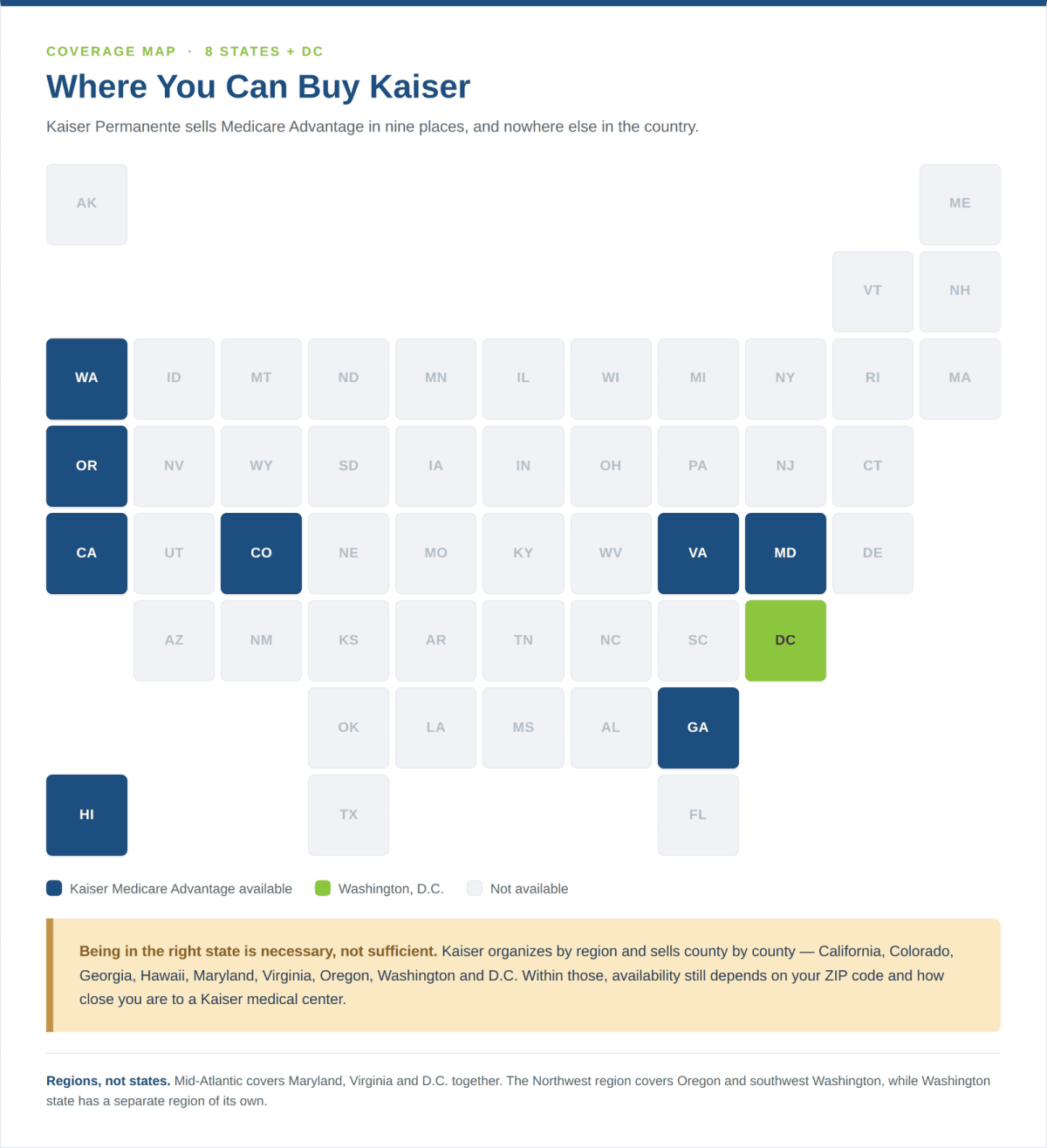
This is the first thing to settle, because for most of the country the answer ends the conversation. Kaiser Permanente serves more than 1.9 million Medicare members, but only across eight states plus Washington, D.C.

Where you can buy it

California, Colorado, Georgia, Hawaii, Maryland, Virginia, Oregon, Washington and the District of Columbia. Availability varies by county within each of those, so being in the right state is necessary but not sufficient — check your own ZIP code.

Where you cannot

Everywhere else. There is no Kaiser plan in Texas, Florida, New York, Illinois or the great majority of the country, and no amount of interest in the star ratings changes that. If you are outside the footprint, our guide to Medicare Advantage plans for 2027 covers the carriers that do sell where you live.

Kaiser also organizes itself by region rather than by state, which is why the Mid-Atlantic region covers Maryland, Virginia and DC together, and why the Northwest region covers Oregon and southwest Washington while Washington state has a separate region of its own. Your region determines your star rating and your plan options.

California is Kaiser’s largest Medicare market by a wide margin, and it is also where Kaiser faces its most serious competition — SCAN Health Plan, Blue Shield of California and Alignment Health all compete there alongside the national carriers. Our guide to Medicare Advantage plans in California covers how that comparison actually shakes out county by county.

Kaiser Permanente Medicare Advantage overview showing 1.9 million members across eight states and DC with 4 to 4.5 star ratings

Compare Kaiser Medicare plans in your area

Kaiser Star Ratings by Region

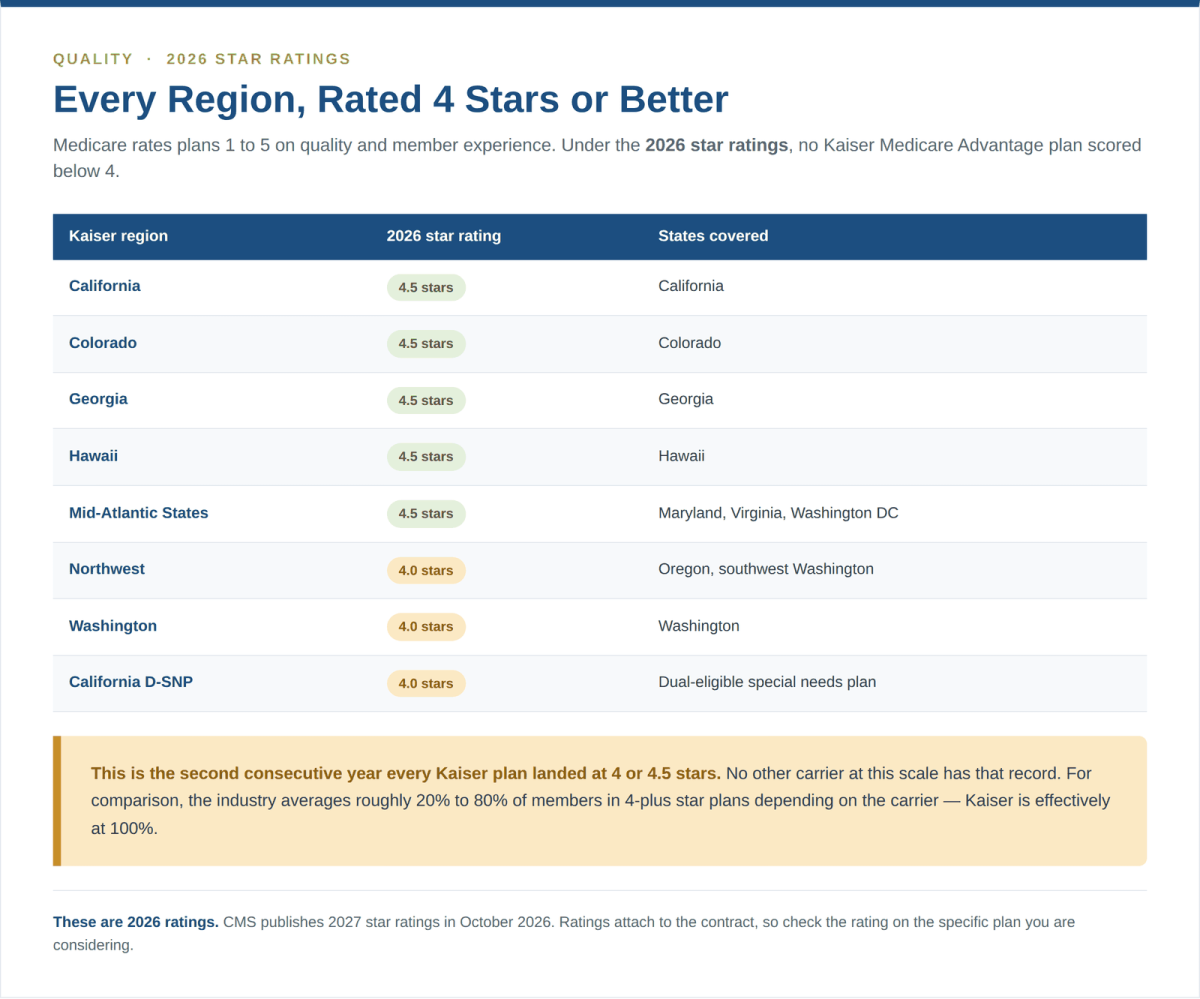
Kaiser Permanente Medicare Advantage 2026 star ratings by region, all plans rated 4 or 4.5 stars
Kaiser region 2026 star rating Where it covers
California 4.5 stars Northern and Southern California
Colorado 4.5 stars Denver, Boulder and surrounding counties
Georgia 4.5 stars Metro Atlanta area
Hawaii 4.5 stars Hawaii — the highest rating available in the state
Mid-Atlantic States 4.5 stars Maryland, Virginia, Washington DC
Northwest 4.0 stars Oregon and southwest Washington
Washington 4.0 stars Washington state
California D-SNP 4.0 stars Dual-eligible special needs plan, California

Senior Advantage and Advantage Plus: The Plan Names Explained

Kaiser does not market its Medicare Advantage plans under the words “Medicare Advantage.” It sells them as Kaiser Permanente Senior Advantage, and there is a second name — Advantage Plus — that causes a lot of confusion because it sounds like a better version of the same plan. It is not.

Senior Advantage — the plan itself

This is Kaiser’s Medicare Advantage HMO product. When someone says they have a Kaiser Medicare plan, this is almost always what they mean. Like the Gold Plus name at Humana, it is a brand covering many individual plans — the specific plan behind it differs by region and county, each with its own premium, copays and plan ID.

Advantage Plus — an optional add-on, not a plan

Advantage Plus is a supplemental benefits package you can add on top of a Kaiser Medicare health plan for an additional monthly cost. It is not a separate Medicare Advantage plan and you cannot buy it on its own. What it includes varies by region, so check the specific package offered where you live rather than assuming.

Advantage Plus has its own enrollment deadline, and it is not the same as the plan’s. You can add it within 30 days of your Kaiser Medicare health plan’s effective date. If you are already a member and want to add it for the following year, that window runs October 15 through December 31 — which is three weeks longer than Annual Enrollment, and easy to miss if you assume December 7 is the last date for everything.

Why Kaiser Works Differently From Every Other Carrier

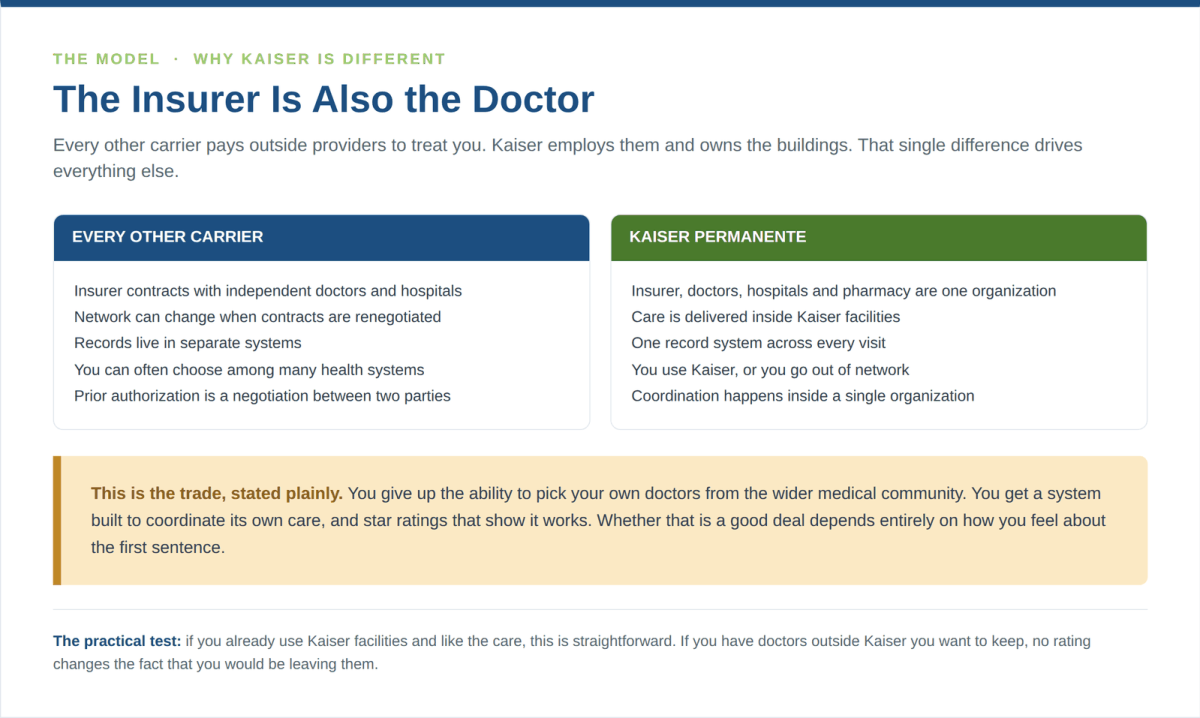
How Kaiser Permanente's integrated model differs from other Medicare Advantage carriers

Every other Medicare Advantage carrier is an insurance company that contracts with independent doctors and hospitals to treat you. Kaiser Permanente is an insurance company that employs the doctors and owns the hospitals. That is not a marketing distinction — it changes what you experience.

1One record, one system. Your primary care doctor, your specialist, the lab and the pharmacy are all inside the same organization and looking at the same file. Nobody has to fax anything. This is the single biggest practical difference members report.

2The network cannot fall out from under you. On a conventional plan, a contract dispute between the insurer and a hospital system can remove your doctors mid-year or at renewal. Kaiser cannot lose a contract with itself, which removes an entire category of risk that every other carrier carries.

3And you use Kaiser, or you go out of network. This is the cost of the other two. You are choosing one health system for everything. Outside of emergencies and urgent care, care received elsewhere is generally not covered. If the specialist you trust is not a Kaiser physician, joining means leaving them.

Kaiser also offers only HMO plans. There is no PPO option, no out-of-network tier to fall back on, and you work through a Kaiser primary care doctor. If provider choice is what you value most, the honest answer is that Kaiser is the wrong carrier for you regardless of its ratings — and Original Medicare vs Medicare Advantage covers the alternative structure worth looking at instead.

Find & Compare Plans Online

Speak with a licensed insurance agent

1-855-454-9051TTY 711

Mon-Fri: 8am-9pm ET

What Kaiser Medicare Advantage Costs

Cost What to expect
$Part B premium You keep paying it — $202.90 a month in 2026 for most people, regardless of which plan you choose.
Plan premium Varies by region and county. Kaiser offers $0 premium plans in some markets and premium plans in others.
+Doctor visits Flat copays at Kaiser facilities. Primary care is typically the lowest, specialists higher.
Hospital stays A daily copay for a set number of days at a Kaiser hospital, then nothing for the rest of the stay.
Annual out-of-pocket maximum Required on every Medicare Advantage plan. The federal ceiling was $9,250 in-network for 2026, with HMO plans averaging $4,636.
Prescription drugs Included on most Kaiser plans and filled at Kaiser pharmacies. Part D out-of-pocket costs are capped at $2,400 in 2027.
Extra benefits Dental, vision, hearing and fitness benefits may be included depending on the plan and region. Not every plan offers all of them.

Kaiser in a Year When Carriers Are Cutting

This is worth setting against the wider 2027 picture. More than one million Medicare Advantage members across the industry face plan exits next year. Humana alone is discontinuing plans covering about 600,000 people, with UnitedHealthcare, Centene and Molina all making cuts of their own.

Kaiser has announced no Medicare Advantage exits for 2027. It is one of the few carriers not contracting, and the structural reason is worth understanding: the exits elsewhere are concentrated in plans rated 3.5 stars and below, because low-rated contracts earn smaller quality bonus payments and become unprofitable first. Kaiser has no plans in that band. Its quality record and its stability are the same fact viewed from two angles.

If you are here because your current plan is being discontinued, two pages are worth reading alongside this one: are Medicare Advantage plans going away in 2027 for the industry-wide picture, and Humana Medicare Advantage plans ending in 2027 if Humana is the carrier that dropped you.

Who Kaiser Suits, and Who It Doesn't

Kaiser fits you if

You already use Kaiser facilities and are happy with the care, you live near a Kaiser medical center, you value coordination and a single record system over picking individual doctors, or you are managing conditions that involve several specialists talking to each other. It also suits people who want the annual plan review to be short — Kaiser’s ratings and footprint move very little year to year.

Kaiser does not fit you if

You have doctors outside the Kaiser system you want to keep, you split the year between two states, you live far from a Kaiser facility, or you want the option of going out of network at a higher cost rather than not at all. A PPO from another carrier, or Original Medicare with a supplement, handles all four of those better.

The one check that settles it. Before anything else, find out how far you actually live from the Kaiser medical center you would use, and whether the specialists you see are Kaiser physicians. Star ratings are the last thing to look at on this carrier, not the first — geography and your existing doctors decide it.

Compare Kaiser Medicare plans in your area

Frequently Asked Questions

  Is Kaiser a good Medicare Advantage plan?

On quality scores, Kaiser is the strongest carrier in the market — every one of its plans rated 4 or 4.5 stars for the second consecutive year, which no carrier of comparable size matches. Whether it is good for you depends on two things the ratings do not measure: how close you live to a Kaiser medical center, and whether the doctors you want are Kaiser physicians. If both work out, it is an excellent plan. If either does not, the ratings will not help you.

  Is Kaiser keeping Medicare Advantage plans?

Yes. Kaiser has announced no Medicare Advantage exits for 2027, which makes it one of the few carriers not contracting in a year when more than a million members across the industry face plan exits. The reason is structural: the cuts elsewhere are concentrated among contracts rated 3.5 stars and below, and Kaiser has no plans in that band.

  What is the difference between Kaiser Senior Advantage and Advantage Plus?

Senior Advantage is the Medicare Advantage plan itself — Kaiser’s HMO product, and what most Kaiser Medicare members are enrolled in. Advantage Plus is an optional supplemental benefits package added on top of a Kaiser Medicare health plan for an extra monthly cost, not a separate plan and not something you can buy on its own. It also has its own enrollment deadline: within 30 days of your plan’s effective date, or October 15 through December 31 if you are already a member adding it for the following year.

  What will happen to Medicare Advantage plans in 2027?

More than one million members across the industry face plan exits, with Humana discontinuing plans covering about 600,000 people and Centene, Molina and UnitedHealthcare all making cuts of their own. Non-renewal letters are dated October 2, 2026, and affected coverage ends December 31. The exits are concentrated among plans rated 3.5 stars and below, which is why higher-rated carriers such as Kaiser are largely unaffected.

  What states offer Kaiser Medicare Advantage?

California, Colorado, Georgia, Hawaii, Maryland, Virginia, Oregon and Washington, plus the District of Columbia. Availability varies by county within each of those, so check your specific ZIP code rather than assuming statewide coverage. Kaiser does not sell Medicare Advantage anywhere else in the country.

  What star rating does Kaiser Medicare Advantage have?

Under the 2026 star ratings, California, Colorado, Georgia, Hawaii and the Mid-Atlantic region each earned 4.5 stars, while the Northwest region, Washington state and the California dual-eligible plan earned 4. That is the second consecutive year in which every Kaiser Medicare Advantage plan rated 4 or higher. CMS publishes the 2027 ratings in October 2026.

  Does Kaiser offer a Medicare Advantage PPO?

No. Kaiser sells HMO plans only. There is no PPO option and no out-of-network tier, so outside of emergency and urgent care your coverage applies at Kaiser facilities. If out-of-network access matters to you, a PPO from another carrier is the structure to look at.

  Can I keep my own doctor with Kaiser?

Only if your doctor is a Kaiser Permanente physician. Kaiser employs its own doctors rather than contracting with independent practices, so joining a Kaiser plan generally means moving your care into the Kaiser system. This is the single most important thing to check before enrolling, and it is not something a star rating offsets.

  How much does Kaiser Medicare Advantage cost?

Premiums are set regionally and vary by county, with $0 premium plans available in some markets and premium plans in others. You keep paying your Part B premium either way — $202.90 a month in 2026 for most people. Beyond that you pay copays as you use care, up to the plan’s annual out-of-pocket maximum.

  Does Kaiser Medicare Advantage include prescription drug coverage?

Most Kaiser Medicare Advantage plans include Part D prescription coverage, filled through Kaiser pharmacies. Confirm on the specific plan before enrolling, since not every plan in every region includes it. Part D out-of-pocket drug costs are capped at $2,400 in 2027, up from $2,100 in 2026.

  What happens if I need care while traveling?

Emergency and urgent care are covered anywhere in the country, as they are on every Medicare Advantage plan. Routine care outside your Kaiser region generally is not. If you spend substantial time in another state, that is a real limitation of the HMO structure and worth weighing before you enroll.

  Why does Kaiser rate so much higher than other carriers?

Star ratings measure things like preventive screenings, chronic condition management, medication adherence and member experience — all of which are easier to deliver when the insurer, the doctors, the hospital and the pharmacy are the same organization sharing one record system. The integration that limits your provider choice is the same integration that produces the scores.

  When can I enroll in a Kaiser Medicare Advantage plan?

Annual Enrollment runs October 15 through December 7, 2026, for coverage beginning January 1, 2027. You can also enroll when you first become eligible for Medicare, during the Medicare Advantage Open Enrollment Period from January 1 to March 31 if you are already in an Advantage plan, or through a Special Enrollment Period if you qualify — including when your current plan is discontinued.

Have Questions?

Speak with a licensed insurance agent

1-855-454-9051

TTY users 711

Mon-Fri: 8am-9pm ET

Find & Compare Plans Online

Speak with a licensed insurance agent

1-855-454-9051TTY 711

Mon-Fri: 8am-9pm ET

ZRN Health & Financial Services, LLC, a Texas limited liability company