Speak with a licensed insurance agent

1-855-454-9051

TTY user 711 Mon-Fri : 8am-9pm EST

Medicare Advantage Plans in California 2027: Costs, Carriers and Coverage

Reviewed by Russell Noga, Licensed Medicare Insurance Broker (all 50 states) — Last updated September 11, 2026

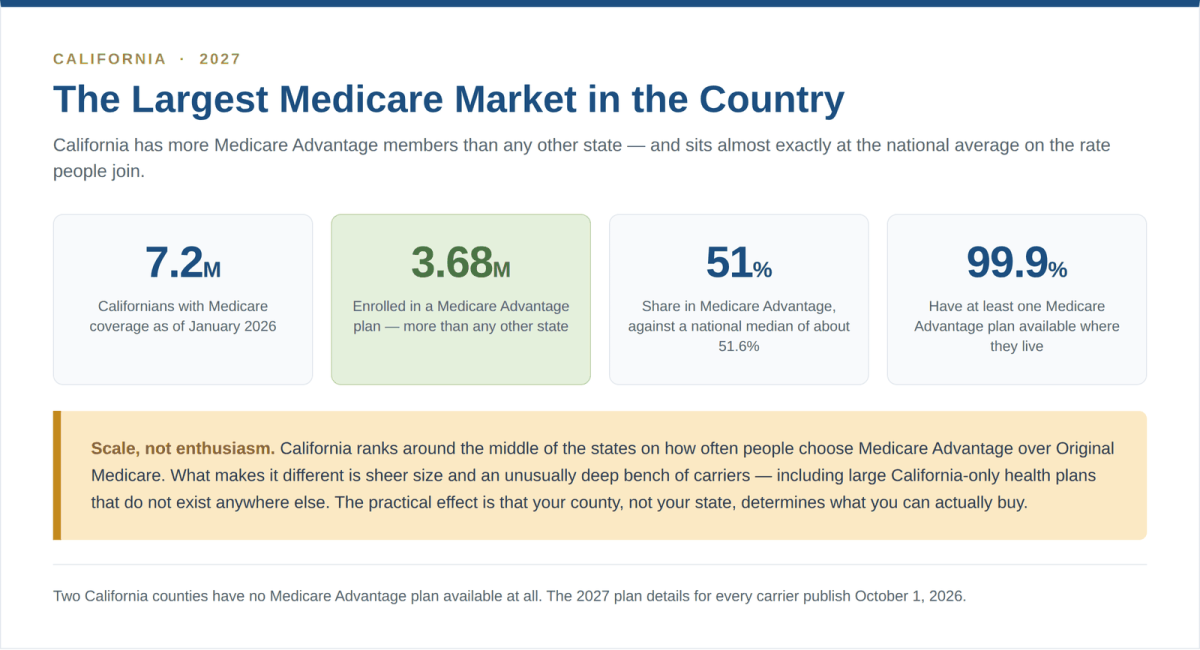
California has more Medicare Advantage members than any other state — about 3.68 million of the 7.2 million Californians on Medicare as of January 2026. What surprises most people is that California is not an outlier on enrollment rate. At roughly 51%, it sits almost exactly at the national median. The state is remarkable for its scale and for the depth of its carrier bench, not for how eagerly Californians choose Medicare Advantage.

That distinction matters, because it changes what you should actually be comparing. In a state this large, with several health plans that operate nowhere else and county-level plan counts that swing from more than a hundred down to zero, the useful question is never “what does California offer.” It is what your county offers. This page covers the 2027 California market: who sells here, what plans cost, how the state’s much-misunderstood birthday rule really works, and when you can act. For the national picture, start with our overview of Medicare Advantage plans for 2027.

Medicare Advantage in California at a Glance

California Medicare market overview showing 7.2 million beneficiaries and 3.68 million enrolled in Medicare Advantage

Nearly every Californian on Medicare has at least one Medicare Advantage plan available — 99.9% of beneficiaries, with only two counties in the entire state having none at all. But availability and choice are very different things. Los Angeles County offers many times what a rural Sierra or far-northern county does, and a carrier that dominates Southern California may not sell a single plan in the Central Valley county next door.

Three things set the California market apart from almost everywhere else in the country:

1California-only health plans, at real scale

Kaiser Permanente, SCAN Health Plan, Blue Shield of California and Alignment Health are serious competitors here — not regional afterthoughts the way local plans are in most states.

2Two separate Blue plans

Anthem Blue Cross and Blue Shield of California are different companies with different networks and different plans. This confuses people every single year, and it is the most expensive mistake on this list.

3The birthday rule

California gives Medicare Supplement holders an annual 60-day window to switch policies with no underwriting — and it does not work the way most people assume it does.

Compare Medicare Plans in California for 2027

The California Birthday Rule, and What It Does Not Do

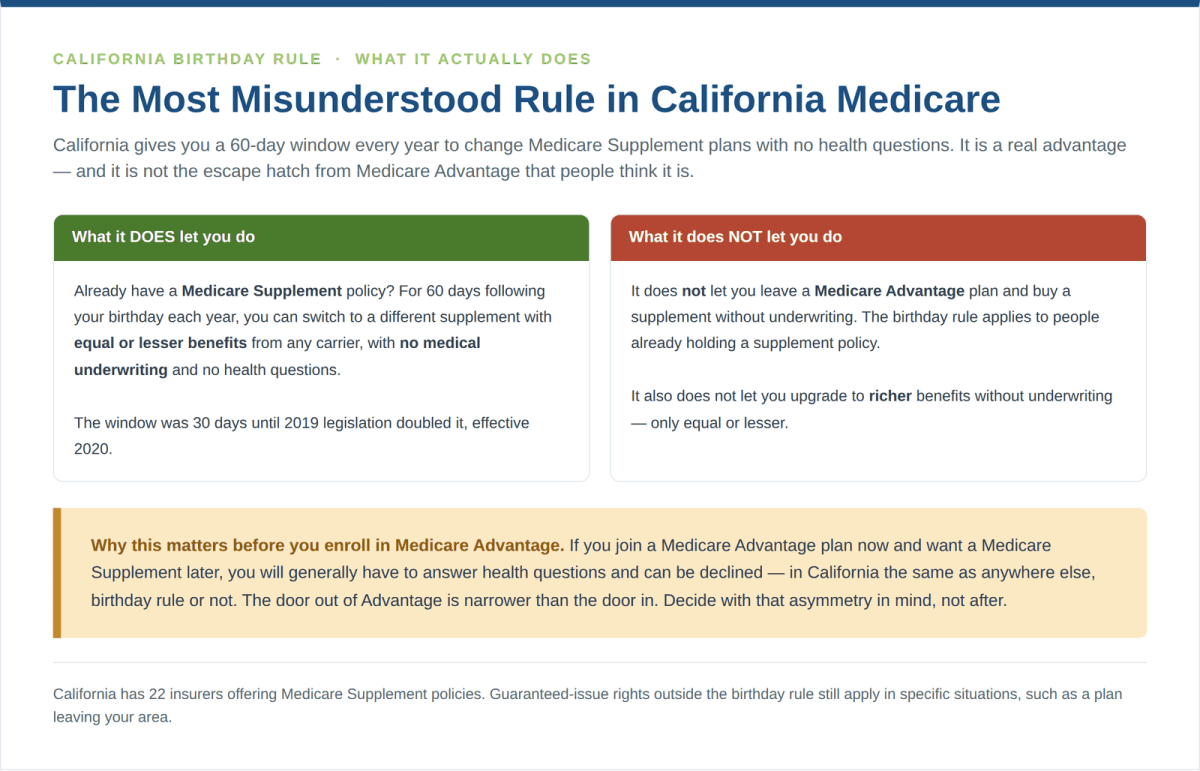
What the California Medicare birthday rule does and does not allow for Medicare Supplement and Medicare Advantage enrollees

This is the single most misunderstood rule in California Medicare, and getting it wrong can cost you the ability to change course later. Here is what it actually says. If you already hold a Medicare Supplement policy, California law gives you a 60-day window each year following your birthday in which you can switch to a different supplement with equal or lesser benefits, from any carrier, with no medical underwriting and no health questions. The window was 30 days until 2019 legislation doubled it, effective 2020.

California has 22 insurers offering supplement policies, so the choice within that window is genuinely wide.

What it does not do. The birthday rule is not an escape hatch from Medicare Advantage. It applies to people who already hold a Medicare Supplement policy.

If you are in a Medicare Advantage plan and want to move to a supplement, you will generally still face medical underwriting and can be declined — in California the same as anywhere else. It also does not let you move up to richer benefits without underwriting, only across or down.

The practical consequence is an asymmetry worth understanding before you enroll rather than after: the door into Medicare Advantage is wide open every year, and the door back out is narrower. That is not a reason to avoid Medicare Advantage — millions of Californians are well served by it —, but it is a reason to make the initial choice deliberately.

Our breakdown of Original Medicare and Medicare Advantage covers where each one wins, and Medigap and Medicare Advantage side by side covers the supplement comparison in more depth.

Which Companies Sell Medicare Advantage Plans in California

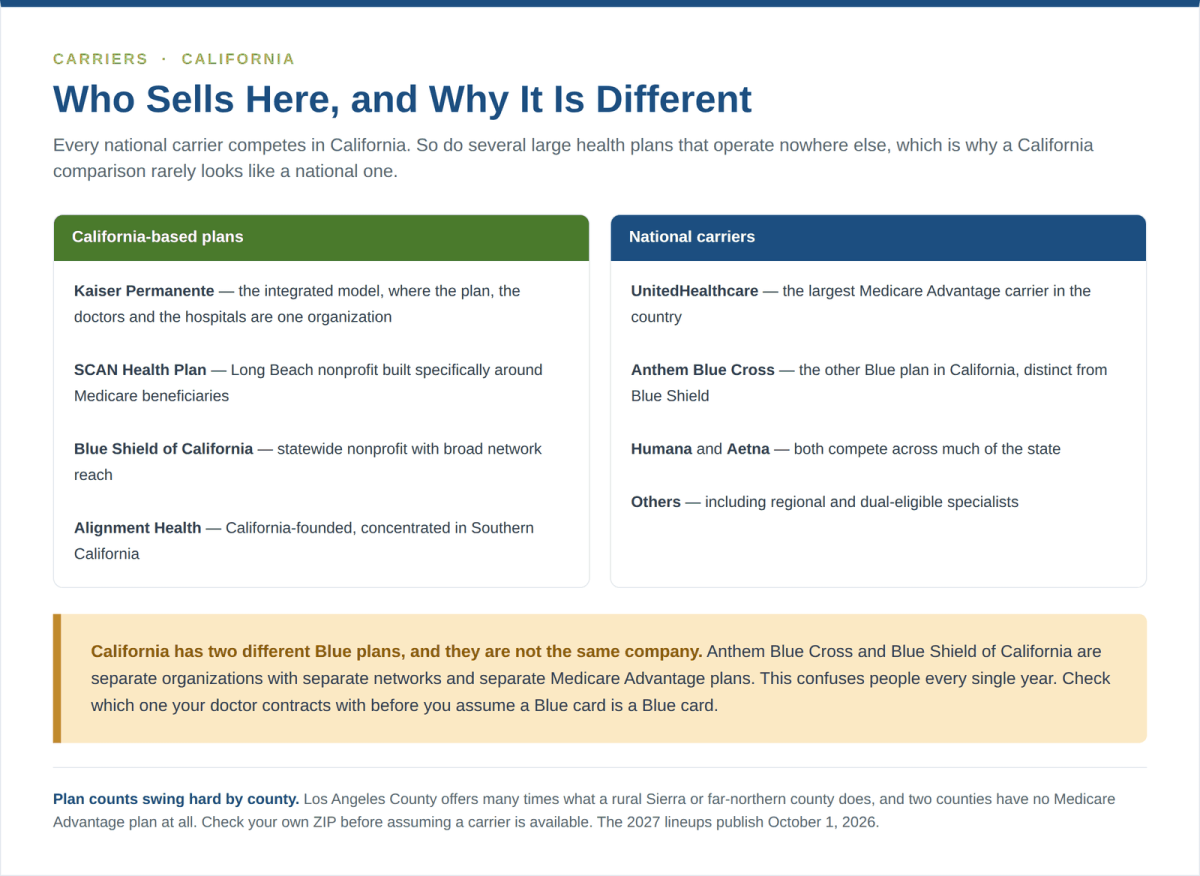
Every national carrier competes in California, and several large health plans that operate nowhere else compete alongside them. Kaiser Permanente is the most distinctive of them: an integrated model in which the health plan, the doctors and the hospitals are all one organization. You give up the ability to shop for providers and get tight coordination in return, and Kaiser has consistently been among the highest-rated Medicare Advantage carriers on CMS quality measures.

SCAN Health Plan, a Long Beach nonprofit, was built specifically around Medicare beneficiaries. Blue Shield of California and Alignment Health round out the significant California-based options.

The Blue Cross and Blue Shield confusion. California is one of the few states with two separate Blue organizations. Anthem Blue Cross and Blue Shield of California are different companies, with different Medicare Advantage plans and different provider networks. A doctor who takes one may not take the other. Check which specific plan your practice contracts with — not just whether they “take Blue.” Our Blue Cross Medicare Advantage plans page covers the Anthem side in detail.

On the national side, UnitedHealthcare is the largest Medicare Advantage carrier in the country and competes across most of California. Humana and Aetna both sell in much of the state.

Several carriers have announced plan reductions for 2027, so a plan available in your county this year is not guaranteed to return — which is exactly why the October 1 plan release matters more than usual this cycle.

California is not the only state where local carriers hold real ground against the nationals. Medicare Advantage plans in Minnesota show the same pattern for a completely different reason — four homegrown nonprofit health plans that grew out of a product called the Medicare Cost plan, which dominated that state until 2018.

What Medicare Advantage Plans Cost in California

Medicare Advantage carriers in California including Kaiser Permanente, SCAN Health Plan, Blue Shield of California, Alignment Health, UnitedHealthcare, Anthem Blue Cross, Humana and Aetna

The monthly premium is the number people fixate on and the least informative one. Plenty of California plans carry a $0 plan premium, which says nothing about what a serious health year would cost you. Here is the whole picture.

What you pay How it works in California
$Part B premium Paid to Medicare every month no matter which Advantage plan you join. Medicare sets the standard amount annually. Some California plans offer a partial giveback, but it is plan-specific and should not be assumed.
Plan premium Often $0, particularly in dense Southern California counties where competition is fiercest. A $0 premium is a marketing headline, not a measure of value.
+Copays and coinsurance Set per plan and per service. Specialist visits, imaging, outpatient surgery and inpatient hospital days are where California plans differ most from one another.
Out-of-pocket maximum Every plan has one, and it defines your worst case. PPOs have two — an in-network limit and a higher combined limit. This pair of numbers is your real financial exposure.
Prescription drugs Most California Advantage plans bundle Part D. There is an annual cap on out-of-pocket costs for covered Part D drugs, which Medicare adjusts each year. Your real cost depends on your specific medications and their tiers.
Out-of-network care Generally not covered on an HMO outside emergencies. Covered at a higher cost share on a PPO. This matters more in California than people expect, given how often care crosses county lines in the metro regions.

None of the 2027 numbers are final yet. Premiums, copays and benefits publish October 1, 2026. Extras such as dental, vision, hearing and over-the-counter allowances may be included depending on the plan and the county, and not every plan offers every extra. Anything quoted about 2027 benefits before October should be read as directional, not confirmed.

Find & Compare Plans Online

Speak with a licensed insurance agent

1-855-454-9051TTY 711

Mon-Fri: 8am-9pm ET

Medi-Medi Plans for People With Both Medicare and Medi-Cal

California has done something most states have not, and if you or a family member qualifies for both Medicare and Medi-Cal it changes the comparison entirely. Through the state’s CalAIM initiative, California has been consolidating dual-eligible coverage into integrated plans it calls Medi-Medi Plans — Dual Eligible Special Needs Plans in which the same organization manages both your Medicare and your Medi-Cal benefits.

What changed, and why it matters

California now only contracts with dual-eligible plans that have an affiliated Medi-Cal plan. Plans without one can no longer enrol new members, though existing members may stay.

Medi-Medi Plans operated in a limited set of counties through 2025 and have been expanding to additional counties since. Availability is still county-specific, so confirm what exists where you live.

The point of the design is coordination: one organization handling both programs, rather than two systems that do not talk to each other. If you qualify, this is usually the first option to look at, not the last.

HMO, PPO and California's County Problem

California is really several distinct markets sharing a state line. Los Angeles, Orange and the Bay Area counties have enormous plan choice and dense overlapping networks. The Central Valley has fewer. The Sierra and far-northern counties have fewer still, and two counties have no Medicare Advantage plan at all. A recommendation that makes sense in San Diego can be useless in Modoc.

1HMO Plans  ·  Lowest cost, tightest network

The dominant structure in California, and the one Kaiser uses. You stay inside a defined network and usually need a referral for a specialist. Lowest cost shares of any plan type, and the wrong choice if you spend significant time outside your service area.

2PPO Plans  ·  More freedom, higher copays

Out-of-network care covered at a higher cost share, and referrals generally not required. Worth the higher copays if you split time between two parts of the state, travel regularly, or want specialist access without prior approval.

3Special Needs Plans  ·  Strict eligibility, deeper coordination

For people with both Medicare and Medi-Cal, or with a qualifying chronic condition. California has one of the largest dual-eligible populations in the country and these plans are widely available, but eligibility rules are strict and you must continue to qualify to stay enrolled.

When You Can Enroll for 2027

California follows the federal Medicare calendar. The Annual Enrollment Period runs October 15 through December 7, 2026, and whatever you choose takes effect January 1, 2027. That is the only window in which anyone can join, switch or drop a Medicare Advantage plan freely.

Window Dates What you can do
Annual Enrollment Period Oct 15 – Dec 7, 2026 Join, switch or drop a Medicare Advantage plan. Change Part D plans. Coverage starts January 1, 2027.
Medicare Advantage Open Enrollment Jan 1 – Mar 31, 2027 Only if you are already in a Medicare Advantage plan. One change, then you are locked in until the next AEP.
Initial Enrollment Period 7 months around your 65th birthday Starts three months before your birthday month and ends three months after.
Special Enrollment Periods Triggered by an event Moving out of your plan’s service area, losing employer coverage, qualifying for Medi-Cal, or your plan leaving your county.

The January window is narrower than most people realize. The Medicare Advantage Open Enrollment Period gives you exactly one change, and it cannot be used to join Medicare Advantage from Original Medicare. Separately, the California birthday rule window runs on your own birthday rather than the Medicare calendar, and it applies only to Medicare Supplement policies — not to Medicare Advantage plans.

Medicare Advantage Plan open enrollment period 2027

How to Find the Best Medicare Advantage Plan in California

Step 1

Start with your ZIP code, not the carrier

California is too varied for a statewide answer. A plan sold in Los Angeles County may not exist in Tuolumne, and two counties have no Medicare Advantage plan at all. Every useful comparison starts at the county level.

Step 2

Check every doctor, and confirm by phone

Look each one up in the plan’s 2027 directory, then call the practice and ask directly. Directories lag behind contract changes. In California this is where the two-Blues confusion does the most damage — “we take Blue Cross” does not mean they take Blue Shield of California.

Step 3

Run your actual prescriptions

Every medication, against the plan’s 2027 formulary, checking the tier and whether it needs prior authorization. Drug costs are the most common February surprise, and formularies are rebuilt annually.

Step 4

Look up the rating on the contract, not the company

CMS assigns star ratings per contract, so a carrier’s national average tells you very little about the plan in front of you. Our guide to top rated Medicare Advantage plans explains how to read them. The 2027 ratings publish in October 2026.

Step 5

Compare the out-of-pocket maximum, not the premium

A $0 premium plan with a high ceiling can cost far more in a bad year than one charging a modest monthly amount. Compare the in-network limit and, on a PPO, the combined limit. Those two numbers are your actual exposure.

Compare Medicare Plans in California for 2027

Frequently Asked Questions

  What is the best Medicare Advantage plan in California?

There is no single best plan in a state this large, and any page naming one is guessing at your circumstances. California has more than fifty counties with materially different plan lineups, plus several California-only carriers that do not compete everywhere in the state. Kaiser Permanente has consistently rated well on CMS quality measures and is a strong fit for people comfortable with an integrated system; SCAN Health Plan was built specifically around Medicare members; the national carriers offer broader geographic reach. The best plan for you is the one that covers your doctors, covers your prescriptions at a workable tier, and sets an out-of-pocket maximum you could absorb in a bad year.

  What company has the best Medicare Advantage plan for 2026?

On the most recent CMS star ratings, Kaiser Permanente placed at or near the top among large carriers on the share of members in 4-star-and-above plans, and it is widely available in California. But company-level averages are a blunt instrument. Ratings attach to individual contracts, so a highly rated carrier can offer a mediocre plan in your county and a lower-rated carrier can offer an excellent one. The 2027 ratings publish in October 2026 and could move these positions in either direction, so treat any company ranking as a starting filter rather than an answer.

  Which Medicare Advantage plans are 5 star?

CMS awards 5 stars to a small number of individual contracts each year, not to companies, and the list changes annually. A 5-star plan also carries a practical advantage worth knowing about: you can switch into one using a Special Enrollment Period at almost any point during the year, rather than waiting for Annual Enrollment. To find out whether a 5-star plan exists in your California county, check the 2027 ratings when they publish in October 2026 through Medicare’s Plan Finder, or see our guide to top rated Medicare Advantage plans.

  Why do people say to stay away from Medicare Advantage plans?

The criticisms are real and worth understanding rather than waving away. Medicare Advantage plans use networks, so your preferred doctor may not be covered. Many require prior authorization for procedures Original Medicare would simply pay for. Costs arrive as copays during a bad health year rather than as a predictable premium. And the decision is easier to make than to reverse — moving back to Original Medicare with a supplement later usually means medical underwriting, and California’s birthday rule does not change that. The counterargument is equally real: every Medicare Advantage plan caps your annual out-of-pocket spending, which Original Medicare on its own does not, and many carry no additional premium.

  How does the California birthday rule work?

If you already hold a Medicare Supplement policy, California gives you a 60-day window each year following your birthday to switch to a different supplement with equal or lesser benefits, from any carrier, with no medical underwriting. The window was 30 days until 2019 legislation extended it, effective 2020. Two limits matter: it does not let you move up to richer benefits without underwriting, and it does not let you leave a Medicare Advantage plan for a supplement without underwriting. It is a supplement-to-supplement rule.

  Are Anthem Blue Cross and Blue Shield of California the same company?

No. They are two separate organizations, and California is one of the few states where both a Blue Cross and a Blue Shield plan operate independently. They have different Medicare Advantage plans, different provider networks and different costs. A practice that contracts with one may not contract with the other, so when you confirm coverage with your doctor’s office, name the specific plan rather than asking whether they take Blue.

  What is a Medi-Medi Plan in California?

A Medi-Medi Plan is California’s name for a Dual Eligible Special Needs Plan, a Medicare Advantage plan for people who qualify for both Medicare and Medi-Cal in which one organization manages both sets of benefits. California now only contracts with dual-eligible plans that have an affiliated Medi-Cal plan, and plans without one can no longer enroll new members. Availability is county-specific and has been expanding, so check what exists where you live. If you qualify, this is usually the first option to evaluate.

  How many Medicare Advantage plans are available in California?

Statewide the number runs into the hundreds, but that figure is close to meaningless for any individual. What matters is your county, and California’s range is extreme: dense Southern California and Bay Area counties offer many times what rural Sierra and far-northern counties do, and two California counties have no Medicare Advantage plan available at all. Overall, 99.9% of California Medicare beneficiaries have at least one plan available where they live.

  When will 2027 California plan details be available?

Carriers publish 2027 plan details on October 1, 2026, two weeks before Annual Enrollment opens. Premiums, copays, networks, formularies and supplemental benefits are not final before that date, and several carriers have signalled reductions for 2027, so a plan available in your county this year may not return. Anything published about 2027 benefits ahead of October 1 should be treated as directional rather than confirmed.

Have Questions?

Speak with a licensed insurance agent

1-855-454-9051

TTY users 711

Mon-Fri: 8am-9pm ET

Find & Compare Plans Online

Speak with a licensed insurance agent

1-855-454-9051TTY 711

Mon-Fri: 8am-9pm ET

ZRN Health & Financial Services, LLC, a Texas limited liability company